An Officer of the Court, Paid by the Client
Every law student in India is told, usually in the first week, that an advocate is an officer of the court. Advocates repeat it for the rest of their careers, often when claiming a seat, a courtesy or an exemption. Clients hear it and are puzzled, with good reason. If my lawyer is an officer of the court, whose side is he on? Does the court pay him? Did it appoint him? Can it fire him?
The short answers are: mine, within limits; no; no; and not quite. What the phrase describes is an order of loyalty, and a division of control between the court and the Bar Council. Both are worth understanding, because they explain a good deal about what your lawyer will and will not do for you.
Where the phrase is written
The Advocates Act 1961 does not call advocates officers of the court. The phrase comes from the Bar Council of India’s own rules, which open the Standards of Professional Conduct and Etiquette with it:
An Advocate shall, at all times, comport himself in a manner befitting his status as an officer of the Court, a privileged member of the community, and a gentleman.1
The idea is English. In England a solicitor is, by statute, “an officer of the Senior Courts”, a status that goes back to the days when attorneys were admitted by the courts, entered on the courts’ own rolls and disciplined by the judges.2 India kept the phrase and gave the roll, the admission and most of the discipline to the Bar Councils instead. That is why the phrase can sound grander here than the arrangements behind it.
Who pays the advocate
The client does. An advocate in private practice is engaged by the client, takes instructions from the client and is paid by the client. The court plays no part in any of that. It does not choose him, does not pay him, and cannot dismiss him from a case the client wants him to conduct.
There are lawyers paid from public money, and none of them is paid by the court either. Public prosecutors are appointed and paid by the government.3 Legal aid lawyers are paid by the legal services authorities under the Legal Services Authorities Act 1987.4 An amicus curiae is asked by the court to assist it in a particular case and is sometimes paid an honorarium, but the appointment lasts for that case and makes him nobody’s employee. The rules in fact forbid a practising advocate to be a full-time salaried employee of anyone at all.5
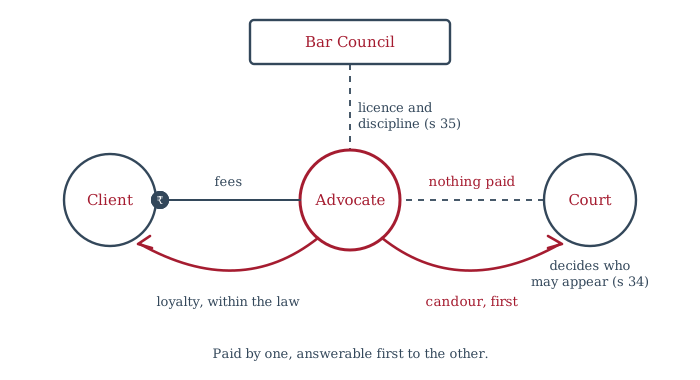
So “officer” here does not mean what it means in “police officer” or “revenue officer”. It means three narrower things.
First: the duty to the court comes first
An advocate owes his client loyalty, skill and confidence. He owes the court something that ranks above all three: he must not mislead it. The Bar Council’s rules put it bluntly. He must restrain his client from “sharp or unfair practices”, must refuse to act for a client who persists in them, and “shall not consider himself a mere mouth piece of the client”.6
This is the part clients most often misread. Your lawyer will argue your case as strongly as the facts and the law allow. He will not lie for you, will not put forward a document he knows to be false, and will not cite a judgment he has not checked. This year the Supreme Court held that citing an unverified, AI-invented judgment is misconduct by the advocate who filed it, whatever the client wanted.7 That limit protects the client as much as it constrains him: a court that can trust what advocates say can act quickly on what his advocate says.
The Supreme Court relied on this same dual duty in 2024 when it held that a client cannot sue his advocate under the Consumer Protection Act. An advocate, it reasoned, is not simply a service provider, because his duty runs not only to the client but also to the court and to the other side.8
Second: the court decides who may appear before it
Enrolment with a State Bar Council gives an advocate the right to practise throughout India, in every court and tribunal.9 That right, remarkably, came into force only in 2011, half a century after the Act was passed. But the right to practise is one thing and the right to stand up in a particular courtroom is another. Section 34 lets each High Court make rules laying down the conditions on which advocates may practise in it and in the courts below it.10
The Supreme Court has drawn the line clearly. In Harish Uppal, the case that declared lawyers’ strikes illegal, it said that the right to appear and conduct cases in court is “a matter on which the Court must and does have major supervisory and controlling power”.11 In 2004 it upheld a Kerala High Court rule that no advocate found guilty of contempt may appear, act or plead in any court until he has purged himself.12
This is the most concrete thing the phrase means. A court cannot employ an advocate, but it can close its own door to him.
Third: the court does not hold the licence
What a court cannot do is take away the licence itself. That belongs to the Bar Council, which alone can suspend or remove an advocate from the roll for misconduct, after a hearing before its disciplinary committee.13
The Supreme Court settled this in 1998. It had earlier, in a contempt case, suspended an advocate from practice for three years. A Constitution Bench in Supreme Court Bar Association held that it had no power to do so, and drew the distinction that still governs:
In a given case it may be possible, for this Court or the High Court, [to] prevent the contemner advocate to appear before it till he purges himself of the contempt but that is much different from suspending or revoking his licence or debarring him to practice as an advocate.14
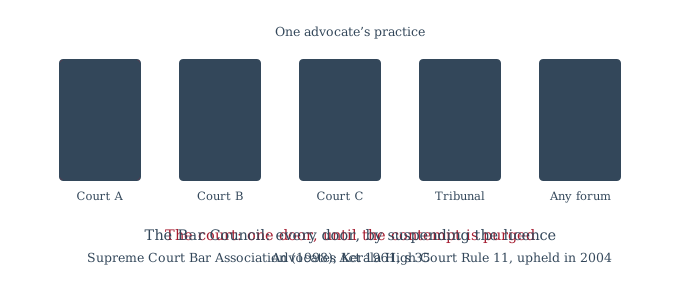
So the officer of the court is an officer whose commission is issued by somebody else. The court supervises his conduct in its presence; the profession, through its elected councils, controls whether he has a profession at all. That division is deliberate. It keeps the Bar independent of the Bench, which is the only way an advocate can be trusted to argue against the State, or against a judge.
What the phrase does not mean
It does not mean deference. The same rules that call an advocate an officer of the court say, in their first rule, that he shall not be servile, and that where there is proper ground for complaint against a judicial officer it is his “right and duty” to take it to the proper authorities.15 An officer of the court owes it honesty, not obedience to whoever happens to be sitting in it. I have written elsewhere about what happens when a regulator forgets that.16
And it does not make advocates a guild with privileges of its own. Justice Krishna Iyer put this in the sentence most often quoted on the subject: “The Bar is not a private guild, like that of ‘barbers, butchers and candlestick-makers’”. The legal profession’s “central function”, he wrote, “is nothing less than the administration of justice”.17 The robes, the reserved seats and the courtesies exist for that function. They are not wages, and the court is not paying them.
Put plainly: the client hires the advocate, the Bar Council licenses him, and the court is owed the truth by him before anyone else is owed anything. That is all “officer of the court” means. It is also, for a client, the best reason to trust what his own lawyer tells him.
Filed under The Legal Profession
- Bar Council of India Rules, Part VI, Chapter II, preamble, made under section 49(1)(c) of the Advocates Act 1961. ↩
- Solicitors Act 1974 (England and Wales), s 50(1). Barristers in England have no equivalent statutory status. ↩
- Bharatiya Nagarik Suraksha Sanhita 2023, s 18, which replaced s 24 of the Code of Criminal Procedure 1973. ↩
- Legal Services Authorities Act 1987, ss 12 and 13. ↩
- Bar Council of India Rules, Part VI, Chapter II, Section VII, r 49. On one consequence of this rule, see Why POSH Fails Women Lawyers. ↩
- ibid Section I, r 4. ↩
- Pooja Ramesh Singh v Jammu and Kashmir Bank Ltd., 2026 INSC 668. See also The Bar Council’s AI Rules Already Exist. ↩
- Bar of Indian Lawyers v D.K. Gandhi PS National Institute of Communicable Diseases, 2024 INSC 410, decided 14 May 2024 (Bela M. Trivedi and Pankaj Mithal JJ). ↩
- Advocates Act 1961, s 30. The section was brought into force on 15 June 2011. ↩
- ibid s 34(1). ↩
- Ex-Capt. Harish Uppal v Union of India, 2002 INSC 523, (2003) 2 SCC 45. ↩
- Bar Council of India v High Court of Kerala, 2004 INSC 311, decided 27 April 2004, following Pravin C. Shah v K.A. Mohd. Ali, 2001 INSC 493. ↩
- Advocates Act 1961, ss 35 and 36. ↩
- Supreme Court Bar Association v Union of India, 1998 INSC 183, decided 17 April 1998, overruling on this point In re Vinay Chandra Mishra, 1995 INSC 179. The bracketed word corrects a typographical error in the reported text. ↩
- Bar Council of India Rules, Part VI, Chapter II, Section I, r 1. ↩
- The Bar Council Had No Power to Bar the NALSAR Batch From Enrolment. ↩
- Bar Council of Maharashtra v M.V. Dabholkar, 1975 INSC 164, decided 13 August 1975, per Krishna Iyer J., para 51. ↩