Why POSH Fails Women Lawyers
Take a woman in her second year at the Bar. Her senior’s chamber is a rented room near the district court with four people in it, none of them on a payroll. An advocate she sees every day in the bar library, a man who is not her senior and owes her nothing, has started sending her messages late at night. One afternoon he says something in the corridor outside Court 3 that she does not repeat to anyone. She wants to complain. To whom?
The honest answer is that it depends on where he said it, which High Court she practises under, and whether she is prepared to file what is, in form, a misconduct prosecution of a member of the Bar before a committee of his colleagues. What it does not depend on is the law Parliament wrote for exactly this. The Sexual Harassment of Women at Workplace (Prevention, Prohibition and Redressal) Act 2013, the POSH Act, almost certainly does not reach her.
The reason lies in how the Act is built.
A door that opens one way
On the complainant’s side, the Act is generous. An “aggrieved woman”, in relation to a workplace, is “a woman, of any age whether employed or not”.1 She does not need a contract, a salary or an appointment letter. And “workplace” is wide: it covers establishments funded or controlled by the government, which takes in the courts, and any private venture carrying on “professional” activity, which takes in a chamber.2 So far, she is in.
Then read on to the machinery. The Internal Committee is constituted by “every employer”. The inquiry proceeds, in the words of section 11(1), “where the respondent is an employee”, under the service rules that apply to him. And when the complaint is proved, the committee recommends that the employer take action under those service rules, or deduct compensation from his salary.3 Every step after the complaint is filed runs through someone who has power over the man complained against.
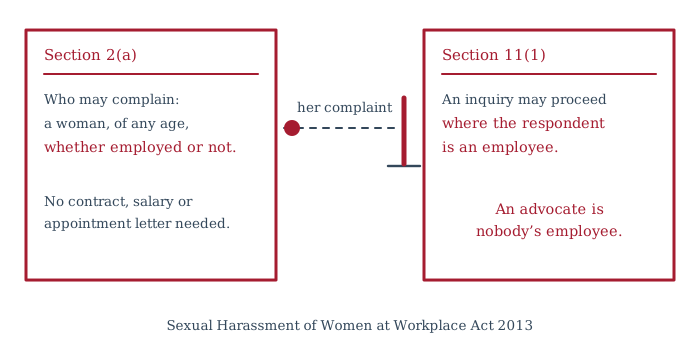
An advocate has no such person, and the profession’s own rules make sure of it. The Bar Council of India’s own rules say that an advocate shall not be a full-time salaried employee of any person, firm or government while he continues to practise.4 The Bar is organised so that its members answer to no employer. The POSH Act is organised so that a respondent answers through one. Put the two side by side and the respondent who is an advocate falls through the space between them.
What the Bombay High Court decided
That is what the Bombay High Court held in July 2025. A women lawyers’ association had asked it to direct the Bar Council of India and the Bar Council of Maharashtra and Goa to set up permanent committees under the Act for complaints by women advocates. A Division Bench of Chief Justice Alok Aradhe and Justice Sandeep Marne dismissed the petition. Advocates are not employees of the Bar Councils, so the Act’s machinery has nothing to attach to. It still covers the Councils’ own staff. For advocates, the remedy is a complaint of misconduct under section 35 of the Advocates Act.5
On the text, that is hard to fault. Section 11 says what it says. The trouble lies in the remedy the reasoning leaves her with.
Section 35 is a different thing
Section 35 is a disciplinary power over a profession. It was not designed for sexual harassment, and it shows at every stage.
Start with who hears it. A complaint goes to the State Bar Council, which refers it to a disciplinary committee of three: two elected members of the Council and one co-opted advocate.6 Every member is a practising lawyer, and two of them owe their seats to the votes of advocates like the respondent. There is no external member. In a profession where women hold, by one count, about two per cent of the elected seats on State Bar Councils, there is usually no woman either.7
Then the clock. Under the POSH Act a complaint must be made within three months of the incident, and the inquiry must be finished within ninety days.8 A disciplinary committee has a year, and if it runs out of time the file is transferred to the Bar Council of India and the clock, in effect, starts again.9
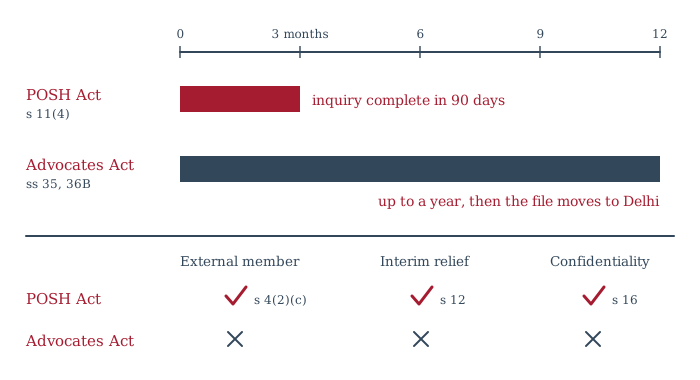
Then what happens while she waits. The POSH Act lets the committee recommend interim relief during the inquiry, such as a transfer or leave.10 What a woman at the Bar needs in the meantime is more specific: that he stop appearing opposite her, stop messaging her, and stay out of the room she works in. Section 35 gives the committee no power to order any of that before it decides the case. And the POSH Act forbids publication of the complaint, the identities of the parties and the proceedings.11 The Advocates Act has no equivalent bar.
None of this makes section 35 useless. It is the only route that can end in suspension or removal from the roll, and some complaints should end there. But it is a prosecution of a professional by his peers, not a workplace inquiry, and telling a woman to use it is telling her that the protection Parliament wrote for every other working woman is not for her. Senior Advocate Mahalakshmi Pavani, arguing for women lawyers in the Supreme Court, put it in one line: “The absence of a traditional employer cannot mean the absence of a workplace or remedy.”12
The Bar was covered before the Act existed
This is the part I find hardest to explain away. Before the Act existed, the Bar was covered in terms.
The Vishaka guidelines of 1997 governed sexual harassment at work for sixteen years without any statute behind them.13 In 2012, finding that they were being ignored, the Supreme Court in Medha Kotwal Lele issued further directions, and one of them was addressed to this profession by name:
The Bar Council of India shall ensure that all bar associations in the country and persons registered with the State Bar Councils follow the Vishaka guidelines.14
It told the Bar Council of India to issue the necessary circulars within two months. But the Court also said why it was giving these directions: they were necessary “until legislative enactment on the subject is in place”. A year later the enactment was in place, built around an employer, and the profession that had been named in the directions was not named in the Act. I can find nothing in the Act or its history to suggest Parliament meant to take lawyers out. The structure did it on its own.
The Court has noticed the problem since. In Aureliano Fernandes in 2023, it directed the statutory bodies regulating professionals, lawyers among them, to check that the committees the Act requires had in fact been constituted.15 But a regulator can only verify committees the Act requires, and two years later the Bombay High Court held that, for complaints between advocates, it requires none.
Where a forum exists, it stops at the court gate
Women lawyers have not waited for Parliament. In 2013, on a petition by two advocates, Binu Tamta and Vibha Datta Makhija, the Supreme Court framed regulations for its own premises and set up a Gender Sensitisation and Internal Complaints Committee.16 Several High Courts followed with regulations of their own, some covering their district courts as well.
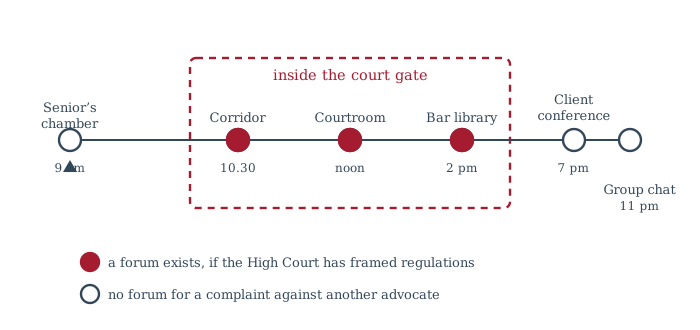
The Himachal Pradesh regulations show how well this model fits the Bar. They protect “any female, of any age, whether employed or not” against harassment “by any person” in the precincts of the High Court and the subordinate courts. There is no employer anywhere in the definition. The committee must finish its inquiry within ninety days. It can admonish, publish the admonition in the cause list, prohibit the respondent from contacting her, and recommend that he be barred from the court precincts for up to a year and referred to his Bar Council.17 Those are the powers a woman in the corridor outside Court 3 actually needs.
The limit is in the word precincts. The forum exists where the court’s authority runs, which is inside the court gate, and only in states whose High Court has chosen to create it. A junior advocate’s working day does not stay inside the gate.
There is one narrow exception worth knowing about. If the harasser is her own senior, the man who runs the chamber, she may be able to argue that he is the “employer” of that workplace, since the Act defines an employer by management and control rather than by salary. A complaint against the employer himself goes to the Local Committee that every District Officer must constitute.18 The argument is a fair reading of the text. As far as I can find, it has never been tested. It also does nothing for the far commoner case, where the man is someone else’s senior, opposing counsel, or a member of the bar association committee.
What the Court is doing now
Two petitions on this are pending in the Supreme Court: a challenge to the Bombay decision by the Supreme Court Women Lawyers Association, and a public interest petition by advocate Seema Joshi asking for the Act to be declared applicable to women advocates.19 On 18 September 2026 a Bench of Justices B.V. Nagarathna and Augustine George Masih took them up and, as reported, said that the Act “cannot be applied in a straitjacket manner to the aggrieved women who belong to the legal profession”. The Bench noted that the Supreme Court’s own regulations reach only its own precincts and that a separate set is needed for the High Courts, the district judiciary, tribunals and quasi-judicial bodies. It asked the parties, the Union among them, to consult and produce model regulations, and asked the Bar Council of India to find out what, if anything, the State Bar Councils already have. The matter is listed again on 25 November.20
I think that instinct is right. Forcing the employer model onto the Bar would mean pretending that Bar Councils employ advocates or that seniors employ juniors, and every respondent would litigate the pretence before anyone litigated the harassment. A regulation built for the profession avoids that fight altogether.
What the model regulations should say
The work is mostly done already, in the Act and in the court regulations. What is needed is to join them up, and to cut the remedy loose from the building.
- Jurisdiction by profession, not by premises. Any complaint by a woman advocate, intern, law student or clerk against an advocate, for conduct arising out of professional work wherever it happened: chamber, court, client meeting, bar function, phone. The Act already reaches “any place visited by the employee arising out of or during the course of employment”. The regulations should reach any place the work takes her.21
- A committee that is not the Bar Council. Standing committees at each State Bar Council and in each district, with a majority of women, an external member, and no office-bearer of the Council or the bar association that the respondent votes in.
- The Act’s clocks. Three months to complain, extendable for cause, and ninety days to finish the inquiry.
- Interim orders that fit the Bar. No contact, no appearing opposite her in pending matters, exclusion from the bar library or chamber block, and the right for a junior to move chambers without her senior’s consent.
- Confidentiality on the terms of section 16 of the Act.
- Findings that bind. Where the committee finds the complaint proved and refers the respondent to the Bar Council, the disciplinary committee should treat its report as the inquiry and decide only on penalty. The Supreme Court gave exactly that direction for government employees in Medha Kotwal Lele: the complaints committee’s report is to be treated as the finding of misconduct, not as a preliminary investigation.22 Without it, a woman proves her case once before the committee and then has to prove it again before his colleagues.
The Act treats her generously as a complainant and then asks her to find an employer for the man she is complaining about. In a profession built so that he can never have one, that request is a refusal. The regulations the Court has asked for can end it, but only if they start from the fact that the Bar has no employers, and build the remedy around the profession instead.
Filed under The Legal Profession
- Sexual Harassment of Women at Workplace (Prevention, Prohibition and Redressal) Act 2013, s 2(a)(i). ↩
- ibid s 2(o)(i) (establishments owned, controlled or substantially financed by the appropriate Government) and s 2(o)(ii) (private ventures carrying on “commercial, professional, vocational, educational …” activities). ↩
- ibid ss 4(1), 11(1) and 13(3). ↩
- Bar Council of India Rules, Part VI, Chapter II, Section VII, Rule 49, made under section 49(1)(c) of the Advocates Act 1961. Rule numbering varies slightly between printed compilations. ↩
- UNS Women Legal Association v Bar Council of India, Public Interest Litigation, High Court of Bombay, decided 7 July 2025 (Alok Aradhe CJ and Sandeep Marne J). For an account of the decision see ThePrint. ↩
- Advocates Act 1961, ss 9(2) and 35(1). ↩
- The figure is given by Jwalika Balaji in ThePrint. I have not been able to check it against the Councils’ own lists, which are not published in one place. ↩
- POSH Act, ss 9(1) and 11(4). The Committee may extend the time to complain by a further three months for reasons recorded in writing. ↩
- Advocates Act 1961, s 36B(1). ↩
- POSH Act, s 12. ↩
- ibid s 16. ↩
- As reported by The Tribune, 24 August 2026. ↩
- Vishaka v State of Rajasthan, 1997 INSC 604, decided 13 August 1997. ↩
- Medha Kotwal Lele v Union of India, 2012 INSC 488, [2012] 9 SCR 895, decided 19 October 2012 (R.M. Lodha, Anil R. Dave and Ranjan Gogoi JJ), para 16(v). The passage “until legislative enactment on the subject is in place” introduces the same set of directions. ↩
- Aureliano Fernandes v State of Goa, 2023 INSC 527, decided 12 May 2023 (A.S. Bopanna and Hima Kohli JJ). The directions on implementing the Act were taken further in Initiatives for Inclusion Foundation v Union of India, 2023 INSC 927. ↩
- Binu Tamta v High Court of Delhi, Writ Petition (Civil) No. 162 of 2013. The Supreme Court’s committee and its annual reports are published on the Supreme Court’s website. ↩
- The Gender Sensitization & Sexual Harassment of Women at the High Court & Subordinate Courts of Himachal Pradesh (Prevention, Prohibition and Redressal) Regulations 2013, regs 2(a), 9(3), 11(1) and 11(2). I have used Himachal Pradesh because its text is published in full. Other High Courts’ regulations differ in detail, and not every High Court has extended them to its district courts. ↩
- POSH Act, ss 2(g)(ii) and 6(1). ↩
- The Association’s petition challenges the decision at n 5. The Court agreed to examine it in August 2025, and the two petitions have been heard together since. Reported at n 20. ↩
- As reported by the Press Trust of India in ThePrint. The words quoted are the order as reported, not as read from the record. ↩
- POSH Act, s 2(o)(v). ↩
- Medha Kotwal Lele, n 14, para 16(i). ↩