The Bar Council’s AI Rules Already Exist
Ask what the Bar Council of India’s rules say about artificial intelligence and the short answer is: nothing. The Standards of Professional Conduct and Etiquette, the part of the Bar Council of India Rules that governs how advocates behave, were written for a profession of typewriters and law reports. The words “artificial intelligence” do not appear in them.
The longer answer is more useful. The rules do not need to name a technology to govern what an advocate does with it, and they say so themselves. Their preamble describes them as “general guides” and warns that “the specific mention thereof shall not be construed as a denial of the existence of other equally imperative though not specifically mentioned”.1 Silence is not permission. Read against the uses advocates are actually making of AI, most of the rules are already there.
Citing what the machine found
This is the one everybody knows about, and it is the one the Supreme Court has already decided.
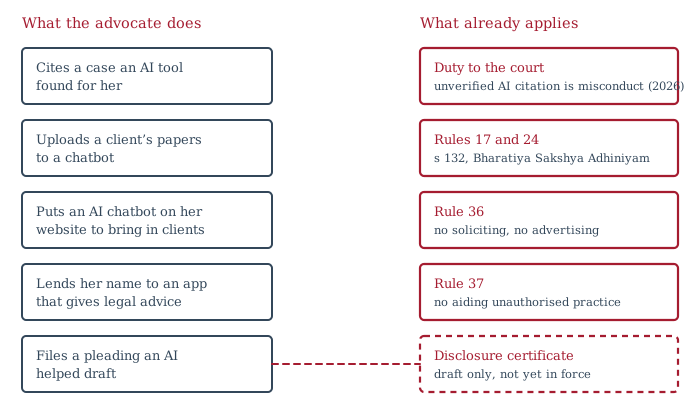
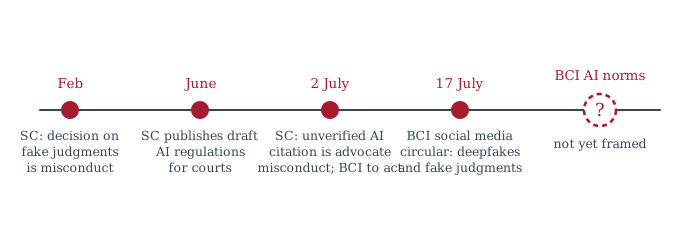
In February the Court took up a trial court order that had relied on four judgments which did not exist, and said that a decision based on such judgments “is not an error in the decision making. It would be a misconduct and legal consequence shall follow.”2 In July, in Pooja Ramesh Singh, it set aside tribunal orders that had relied on hallucinated precedents and held that citing a fake or hallucinated judgment without verifying it is misconduct on the part of an advocate.3
No new rule was needed for that. An advocate has always been answerable for what he puts before a court. Section I of the Standards, the duty to the court, forbids influencing a decision “by any illegal or improper means”, and the duty of candour that the courts enforce does not ask where a false statement came from. If you would be answerable for a case your junior invented, you are answerable for one a chatbot invented. I have written separately about why the profession was primed for this.4
Uploading the client’s papers
This is the one almost nobody talks about, and it is probably the most common breach in practice.
An advocate who pastes a client’s plaint, a draft settlement or a medical report into a consumer chatbot has disclosed it to a third party. Depending on the product’s terms, that third party may keep it, read it, or use it to train the next version. Rule 17 forbids an advocate to commit, directly or indirectly, a breach of the statutory privilege for professional communications, which was section 126 of the Evidence Act and is now section 132 of the Bharatiya Sakshya Adhiniyam 2023. Rule 24 forbids him to do anything “whereby he abuses or takes advantage of the confidence reposed in him by his client”.5
Neither rule mentions software, and neither needs to. The question is the one any advocate would ask before handing a file to a stranger: has the client agreed, and what will the stranger do with it? A tool that contractually keeps the data private and does not train on it is closer to a typist. A free chatbot that may train on what it is given is closer to reading the brief aloud on a train.
The chatbot that brings in clients
Rule 36 forbids an advocate to “solicit work or advertise, either directly or indirectly”, and lists the methods: circulars, advertisements, touts, personal communications.6 A chatbot on an advocate’s website that answers a stranger’s question, tells him he has a strong case and invites him to book a consultation is a personal communication with a prospective client, written by a machine and sent at scale. It is hard to see how it differs from a tout except that it never sleeps.
The Bar Council has started to notice this side of things. Its circular of 17 July on social media brings the old bar on advertising to bear on online content and treats AI-generated and deepfake material, fake judgments and fabricated cause lists as serious breaches.7 It does not mention client-facing chatbots, but its logic covers them.
Lending your name to an app
Rule 37 is the oldest rule in the set that turns out to be about AI. An advocate “shall not permit his professional services or his name to be used in aid of or to make possible the unauthorised practise of law by any agency”.8
Under the Advocates Act only advocates may practise law, and practising without enrolment is an offence.9 A company that sells an app giving people specific legal advice on their own facts is, on any ordinary reading, at the edge of practising law. When it puts an advocate’s name and enrolment number on that advice to make it look reviewed, Rule 37 is the rule that applies to him. The word “agency” was written with other things in mind, but it fits a software company comfortably.
The one gap: telling the court
There is one question the old rules do not answer: does an advocate have to tell the court that AI helped prepare what she has filed?
Nothing in the Standards requires it. The Supreme Court’s draft Regulations for Use of Artificial Intelligence in Courts, published in June, would. Under draft regulation 43(3), where a party or her lawyer uses an AI tool in preparing a document, pleading or evidence, its AI-assisted character must be disclosed to the court when it is filed, by a declaration in a prescribed form. Under 43(6), if the material turns out to be false “by reason of its AI-generated character”, the person who filed it bears full responsibility and may not rely on the AI as a defence.10 The comment period closed on 15 July. The regulations are not yet in force.
What the Bar Council is supposed to be doing
In Pooja Ramesh Singh the Supreme Court asked the Bar Council of India to constitute a committee to frame guiding principles for advocates, and the disciplinary consequences of breaching them. That was on 2 July. As far as I can find, nothing has been published since, either from a committee or by way of a draft.
When the committee does sit, most of its work is already done, and it should resist the temptation to write an AI code from scratch. What the existing rules leave open is narrower:
- What verification means. Misconduct now turns on citing without verifying. The rules should say plainly that verifying a citation means reading the judgment from an authoritative source, not asking a second chatbot whether the first one was right.
- Which tools may see client data. A short standard: client material goes only into tools that do not retain it or train on it, unless the client has agreed in writing.
- Supervision. Most AI use in chambers is by juniors and clerks. The advocate who signs the filing should be answerable for their use, as he already is for their drafting.
- Telling the client. Whether AI was used, and whether time a machine took minutes over is being billed as hours.
- Graded consequences. A careless junior who missed one fake citation and a senior who filed ten without reading any should not face the same penalty. The committee was asked for consequences; it should give a scale.
All of this is the old ethics applied to a new tool, which is all the profession has ever needed from its rules. The preamble got there first: what is not specifically mentioned may be “equally imperative”. An advocate waiting for the Bar Council to say something about AI before changing how she works is waiting for a rule she is already bound by.
Filed under The Legal Profession
- Bar Council of India Rules, Part VI, Chapter II, preamble, made under section 49(1)(c) of the Advocates Act 1961. Rule numbering varies slightly between printed compilations. ↩
- Gummadi Usha Rani v Sure Mallikarjuna Rao, Supreme Court of India, order of 27 February 2026 (P.S. Narasimha and Alok Aradhe JJ). The words quoted are as reported by The Free Press Journal. ↩
- Pooja Ramesh Singh v Jammu and Kashmir Bank Ltd., 2026 INSC 668, decided 2 July 2026. ↩
- Why Indian Advocates Cite Cases They Have Not Read. ↩
- Bar Council of India Rules, Part VI, Chapter II, Section II, rr 17 and 24; Bharatiya Sakshya Adhiniyam 2023, s 132, which replaced s 126 of the Indian Evidence Act 1872 from 1 July 2024. ↩
- ibid Section IV, r 36. ↩
- Bar Council of India, Circular BCI/D/4659/2026, 17 July 2026. For a close reading see The Cyber Blog India. ↩
- Bar Council of India Rules, Part VI, Chapter II, Section IV, r 37. ↩
- Advocates Act 1961, ss 29, 33 and 45. ↩
- Supreme Court of India, draft Regulations for Use of Artificial Intelligence (AI) in Courts, 2026, regs 43(3) and 43(6), published with the Court’s notice of 3 June 2026; the time for comments was extended to 15 July 2026 by notice of 16 June 2026. The draft and both notices are reproduced on the Allahabad High Court’s website. ↩