The Bar Council Had No Power to Bar the NALSAR Batch From Enrolment
On the morning of 13 August 2026, the Chairman of the Bar Council of India directed every State Bar Council in the country not to enrol anyone who had graduated from NALSAR University of Law that year. Not the students who had done the thing complained of. All of them.1
By the evening the direction had been withdrawn. By midnight the inquiry that survived it had been dropped too, and the proceedings closed. The whole episode lasted about a day.2
It would be easy to file that under embarrassments and move on. I think that would be a mistake, because the power the Council asserted has never been disclaimed. Only its exercise was abandoned.
What the students actually did
On 23 July, about seventy students of NALSAR’s graduating batch sent a representation to their own Vice-Chancellor. It asked the university to reconsider a reported proposal to invite the Chief Justice of India as chief guest at their convocation. Their reason was his conduct in a hearing three days earlier concerning alleged police excesses against protesters in Delhi, where he had reportedly declined to look at video material: we are not interested in videos, we don’t have time to watch them. Around 380 students from junior batches later associated themselves with the letter.3
That is the conduct. A private letter, addressed to their own university, about who should hand them their degrees. Not a protest outside a court. Not a statement to the press. Not a word about any pending case. They declined to celebrate, and they said so to the only body that could act on it.
The Council’s stated reason for what followed was this: a student “having no regard or respect for the highest Judicial Office of the country, is not expected to be a responsible or sensible Advocate.”4
The Bar Council does not enrol anybody
Before anything else, there is a problem of plumbing.
Enrolling advocates is not the Bar Council of India’s job. It is the job of the State Bar Councils. Section 6(1)(a) of the Advocates Act says so in terms: it is the function of a State Bar Council “to admit persons as advocates on its roll”. Section 24 then says that a person who is a citizen, is twenty-one, holds a law degree from a recognised university and has paid the fee shall be qualified to be admitted.5
That is not permissive language. It confers an entitlement. And nothing in the Act gives the national Council a power to switch it off.
The only provision that comes close is section 7(1)(g), which gives the Bar Council of India “general supervision and control over State Bar Councils”.6 But supervision of a body cannot mean the power to instruct that body to break the statute it administers. A State Bar Council that received a qualified applicant and turned him away on Delhi’s say-so would itself be acting unlawfully. Read as the direction needed it to be read, that one clause would let the Council suspend section 24 for any group of graduates it disliked, which is another way of saying the qualification provisions of the Act mean nothing.
There is a second gap. The Council’s powers over individuals are disciplinary powers over advocates, people already on a roll. A graduate who has not been enrolled is not an advocate. He sits outside that machinery altogether. So the students were too junior for the disciplinary route and enrolment was not the Council’s to withhold. The direction fell into a gap in both directions at once.
Parliament already decided what disqualifies you
Suppose all that away. Suppose someone in the system could refuse enrolment for conduct. For what conduct?
Parliament answered that, and answered it narrowly. Section 24A disqualifies a person convicted of an offence involving moral turpitude, or convicted under the Untouchability (Offences) Act, or dismissed from State service on a charge involving moral turpitude. And even then the disqualification expires after two years.7
Read that list against the facts. It is keyed to convictions, not conduct. A person convicted of an offence that does not involve moral turpitude is not disqualified at all. A person convicted of one that does is disqualified for two years and then walks in.
So Parliament’s considered view is that a criminal conviction may be no bar to the Bar. Against that, the proposition that a letter to a Vice-Chancellor is a bar, an indefinite one, “till further orders”, cannot be stated without collapsing.
The rule the Council forgot it wrote
Here is the part I keep returning to.
The Bar Council of India writes the Standards of Professional Conduct and Etiquette that govern every advocate in India. Open them at the first rule, in the section on an advocate’s duty to the court. An advocate shall conduct himself with dignity and self-respect, and he may, without fear, submit a grievance against a judicial officer to the proper authorities.8
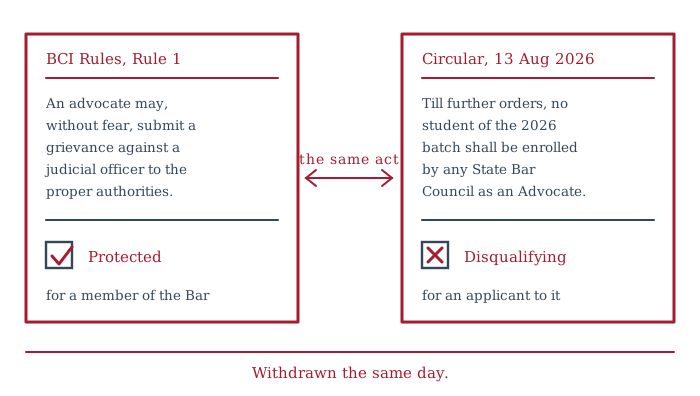
The Council’s own rules protect a qualified advocate who complains about a judge. The direction of 13 August proposed to keep students out of the profession for complaining about a judge, through a channel considerably more proper than the one the rule contemplates, since a convocation is not a court and a letter to your own Vice-Chancellor is not a public attack on anyone.
So the same act is protected in a member of the Bar and was treated as proof of unfitness in someone seeking to join it. No account of professional regulation survives that. It would mean admitting to the profession only those who lack a quality the profession explicitly protects once you are in.
Underneath the inconsistency is a confusion the Advocates Act does not make. An advocate owes a duty to the court, not to mislead it, not to obstruct it, to be candid with it. That duty is real and it is demanding. It is not a duty of personal deference to the person holding the office. Nothing in the Act, the Rules or the cases makes deference a qualification. An independent Bar is not a polite one, and the whole architecture of the Act, self-regulation, a closed list of disqualifications, discipline only after a hearing, exists to keep entry to the profession out of reach of exactly this kind of pressure.
What the withdrawal does not fix
The Council reversed itself quickly, and said the right things while doing it: that no student should suffer without fault on his part, and then that the batch had no role in any of it at all.9 Both statements are true. Both were equally true on the morning the direction was issued, on facts that were already available. A conclusion reached in the evening from evidence that existed in the morning is not new information. It is an admission.
Two things survive the withdrawal.
The first is the lesson left behind. Every law student in India now knows that the body which controls entry to their profession will, on the strength of nothing, respond to their political speech by threatening to end a career before it starts. Whether the threat is carried out turns out to depend on how loudly the profession objects. That is a chilling effect in the ordinary sense, and it does not lift when the circular does.10
The second is that the reversal came from the wrong place. It came from pressure, from senior advocates, the President of the Supreme Court Bar Association, students, the legal press, and not from law. That is a fragile protection, because it works best for those who are already visible. Five hundred graduates of a national law university with a loud alumni network and the attention of the legal media got an answer in a day. It is worth asking what the answer would have been for a law college nobody writes about.
One person in this story behaved exactly as he should have. Asked to supply a list of students who had signed a letter, NALSAR’s Vice-Chancellor did not comply and did not grandstand. He replied that the university would have to consider whether conducting such an inquiry “will be a constitutional exercise of its powers”, and referred the question to the body competent to decide it.11 Faced with a demand from the regulator of the profession his students were about to enter, he did not ask whether he should comply. He asked whether he lawfully could. Had he simply sent the names, this would have ended very differently.
The thing that still needs saying
The proceedings are closed. The question is not.
What is needed now is not an apology, which costs nothing and settles nothing. It is a disavowal, a resolution of the Council, recorded and published, that it has no power to withhold enrolment from a qualified applicant except under section 24A, and that speech is not a ground of disqualification.
Until something like that exists, the direction of 13 August has not disappeared. It has simply become a precedent, sitting on a shelf, available to whoever next holds the office that issued it. Fitness for the Bar is a matter of competence and integrity. It has never been a matter of deference, and a profession that begins selecting for silence at the door will not notice what it has lost until it needs someone willing to speak.
Postscript: the Court has now answered it
Three weeks after this was written, the Supreme Court held that the Bar Council of India has no power over law students at all. The case is Mihira Sood and Anr. v. Bar Council of India and Ors., Diary No. 49499 of 2026, decided on 3 September 2026 by a Bench of Chief Justice Surya Kant, Bagchi and Mohana JJ.12
The reasoning, as reported, runs along the two gaps set out above. The Advocates Act “does not confer any express or implied power upon the BCI or any State Bar Council to take any disciplinary action against the students of law”, because “such a power is preceded by registration of a law graduate as an advocate under the said Act”. As for students, “it is their parent institution or the authority prescribed under the regulations/byelaws of such institution which alone are competent to take disciplinary action”. The Court declared “all communications dated August 13 or subsequent modified communication to be without any authority of law”, made the interim directions absolute, and disposed of the petition.13
That is a better outcome than the one asked for above. What this essay wanted was a resolution of the Council disavowing the power. What exists instead is a holding that the power was never there. A disavowal can be reconsidered by whoever next holds the office. A construction of the Advocates Act cannot.
It also repairs the defect identified at the end of the last section. The August reversal came from pressure rather than from law, which is a protection that works only for those loud enough to attract it. This does not depend on who is watching. The law college nobody writes about is now covered by the same holding as the national law university with the alumni network.
Two qualifications, in the spirit of the rest of this site. The words quoted above are taken from a news agency report of the order, not from the order itself, which I have not read. And there is no neutral citation here, because the decision has not yet appeared on Ratio: its 2026 listing runs to 2026 INSC 938, and every number above that, together with every number missing from the listing below it, returns nothing.14 I will add the citation and the link when the judgment is published.
Filed under The Legal Profession
- The direction read: “Till further orders, no student of NALSAR University of Law, who has obtained the Law Degree in the year 2026, shall be enrolled by any State Bar Council as an Advocate.” The circular is dated 13 August 2026 and the direction is quoted from it as reported; see Outlook. ↩
- The withdrawal and the closure of the proceedings are reported by Outlook and NewsGram. Reports differ on whether the second and third steps fell late on 13 August or early on 14 August. ↩
- See Scroll.in, which reports the representation of 23 July 2026 and the remarks attributed to the Chief Justice at the hearing of 20 July 2026. ↩
- As reported at n 1. ↩
- Advocates Act 1961, ss 6(1)(a) and 24(1). Section 17 requires every State Bar Council to prepare and maintain the roll. ↩
- ibid s 7(1)(g). ↩
- ibid s 24A. ↩
- Bar Council of India Rules, Part VI, Chapter II, Section I, Rule 1, the first of the rules on an advocate’s duty to the court, made under section 49(1)(c) of the Advocates Act 1961. Rule numbering varies slightly between printed compilations. ↩
- “No student shall be made to suffer without any fault on his part”; and, on closure, that the 2026 batch had no role in any “disturbance or movement”. Reported at n 2. ↩
- On the chilling effect of an overbroad restriction on speech, see Shreya Singhal v Union of India, 2015 INSC 257. ↩
- Prof. Srikrishna Deva Rao, Vice-Chancellor, as reported by Siasat. ↩
- Mihira Sood and Anr. v. Bar Council of India and Ors., Diary No. 49499 of 2026. The Bench and the outcome are reported by Business Standard (Press Trust of India), The Hindu and The Tribune. The petitioners are two NALSAR alumni, Mihira Sood and Abhishek Tiwari; senior advocate K. Parameshwar appeared for them. ↩
- The passages in quotation marks are the order as quoted in the Press Trust of India report. They are reproduced here as reported and not as read from the record. ↩
- Checked 3 September 2026. Ratio’s 2026 listing carries 855 judgments and stops at 2026 INSC 938. I also requested each of the 83 numbers missing from that listing and the forty numbers above it; none exists. Rather than print a citation I have not verified, I have printed none. ↩