Forbidden to Advertise, Paid by No One
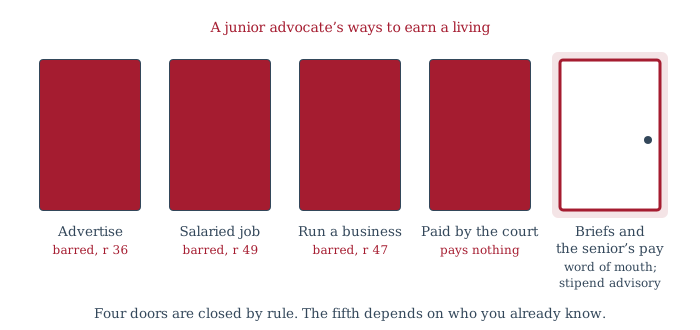
A newly enrolled advocate in India may not advertise. While practising, a new advocate may not take a full-time salaried job, and may not run a business. The court in which the advocate appears pays nothing. What is left is whatever a senior chooses to pay a junior, and whatever briefs arrive through people who already know the advocate. For a first-generation lawyer, both are often close to nothing.
So the question junior advocates keep asking is a fair one. If the Bar Council closes every other way of earning a living, why does the Bar Council not pay a stipend? And if advocates are officers of the court, why does the court not pay them? The answers say a good deal about how the profession has arranged its costs.
What the rules close
The advertising ban is rule 36 of the Bar Council of India’s conduct rules:
An advocate shall not solicit work or advertise, either directly or indirectly, whether by circulars, advertisements, touts, personal communications, interviews not warranted by personal relations, furnishing or inspiring newspaper comments or producing his photographs to be published in connection with cases in which he has been engaged or concerned.1
Since 2008, an advocate may have a website, but only with the particulars the Bar Council of India has approved: name, contact details, enrolment details, qualifications and areas of practice. Anything more is treated as a breach of rule 36. The ban is not loosening. In July 2024 the Madras High Court directed action against advocates listed and rated on JustDial, Sulekha and Quikr, and held that those platforms could not claim the protection given to intermediaries. The Bar Council of India then issued cease-and-desist notices.2 In July 2026 the Supreme Court issued notice on a petition asking the Bar Council to police advocates’ promotional reels and influencer-style videos.3
The other two doors are closed by rules 47 and 49. An advocate “shall not personally engage in any business”, and shall not be a full-time salaried employee of anyone while practising.4 I have written about what these rules allow and forbid in more detail.5 Teaching, writing and part-time work with the State Bar Council’s consent remain open, but they are side income. They do not pay rent.
Why the court does not pay
The court does not pay because it does not employ the advocate. An advocate in private practice is engaged and paid by the client. That separation is deliberate. An advocate on the court’s payroll could not be relied on to argue against the court’s own administration, or to challenge a judge. Where public money does pay lawyers, it comes from the government (public prosecutors) or from the legal services authorities (legal aid panels), not from the court.6 Calling the advocate an “officer of the court” describes a duty of candour. It does not describe a salary.
The court fees litigants pay do not go to the courts either. They go into the State’s treasury. That point turns out to matter for what the Supreme Court has recently proposed.
Why the Bar Council does not pay
The Bar Councils are regulators funded mainly by advocates. They have little money, and the Supreme Court has limited what they may collect. In 2024, in Gaurav Kumar, it held that State Bar Councils cannot charge new entrants more than the enrolment fee the Advocates Act fixes, and struck down enrolment charges that had run into tens of thousands of rupees.7 The judgment was right, but it means the Councils cannot pay for new schemes by charging new entrants more.
Lack of money is only part of the answer, though, because the Act already provides for a fund. A State Bar Council may constitute funds for “giving financial assistance to organise welfare schemes for the indigent, disabled or other advocates”, and may accept grants and donations into them.8 The Bar Council of India has the same power.9 A stipend for advocates in their first years fits comfortably inside “other advocates”. The power exists. What has been missing is a decision to raise the money and use it this way.
What the Bar Council of India chose to do instead was to ask senior advocates to pay. After the Delhi High Court asked it in July 2024 to decide a representation on the subject,10 it issued a circular on 15 October 2024 recommending a minimum stipend of ₹20,000 a month for junior advocates in urban areas and ₹15,000 in rural areas.11 The circular is a recommendation. It is not a rule of conduct, so a senior who pays a junior less commits no misconduct. The Bar Council has used its rule-making power to forbid a junior to advertise. It has not used the same power to require a senior to pay.
Some States have stepped in. Answering a question in the Lok Sabha in February 2026, the Union Law Ministry said that Kerala, Tamil Nadu, Andhra Pradesh and Jharkhand have introduced stipend or financial assistance schemes for junior advocates, through the State government, the State Bar Council or Bar Associations. The same answer said the Bar Council of India “is aware that early-career income challenges are faced by a large segment of junior advocates”.12 In most States, there is nothing.
What the Supreme Court has proposed
In June 2026, hearing a petition by women advocates, a bench led by Chief Justice Surya Kant said that “a Young Lawyers’ Professional Assistance Fund must be created”. Under the proposal, the fund would be controlled by the High Courts or by an autonomous body set up by the Union and the States, not by the Bar Councils. It would pay first-generation and disadvantaged advocates a monthly stipend for their first three years, taper off after that and end within about seven years. The Court suggested three sources of money: donations from senior advocates, encouraged by tax exemptions; a part of the court fees the Union and the States collect; and costs imposed by courts in litigation. Advocates who later establish a practice would repay the fund.13
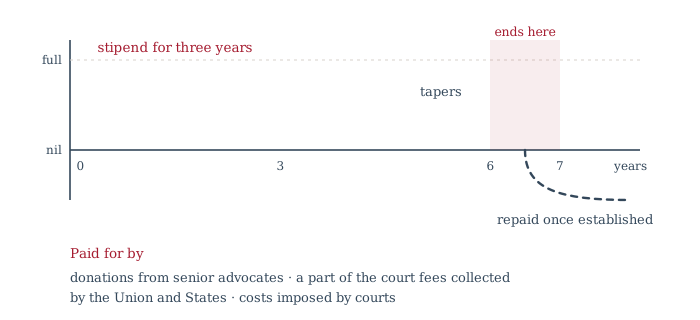
The proposal answers the question in this essay’s title. It treats court fees as the natural source: litigants already pay the State for the use of the courts, and a part of that money could support the advocates without whom the courts cannot function. Because the fund would sit with the High Courts and not with the judges hearing a particular case, it would not make any advocate the court’s employee. The proposal is still only a proposal, and it needs the Union and the States to agree to give up part of their revenue.
Who pays for the ban
The rules against advertising and business have reasons behind them. Advocates are meant to compete on competence and reputation, not on marketing budgets, and to keep their working time for the profession. But every restriction has a cost, and these costs fall unevenly. An advocate with twenty years of reputation loses nothing from the advertising ban. A junior with no family in the profession loses the only means of telling anyone the practice exists. The ban protects the established Bar at the expense of the newest members of it.
That is the strongest argument for a stipend, and for deciding who pays it. If the profession forbids its newest members to look for work and to earn in other ways, the profession should carry part of the cost of their first years. The Bar Council has two tools it has not yet used: a binding minimum stipend for juniors who work in seniors’ chambers and law firms, and a fund under section 6(2). The Supreme Court has offered a third, paid partly from court fees. Any of them would be better than the present arrangement, under which the rules tell a young advocate what not to do and leave the cost of obeying them to the advocate’s family.
Filed under The Legal Profession
- Bar Council of India Rules, Part VI, Chapter II, Section IV, r 36. The website proviso and its schedule were added by Resolution No. 50/2008 dated 24 March 2008. ↩
- P.N. Vignesh v Chairman and Members of the Bar Council, Madras High Court, W.P. Nos. 31281 and 31428 of 2019, decided 3 July 2024 (S.M. Subramaniam and C. Kumarappan JJ). For the Bar Council of India’s press release of 8 July 2024 and its notices to the platforms, see the Ministry of Law and Justice’s written reply in the Lok Sabha, “Regulation for Online Legal Services”, Press Information Bureau, 9 August 2024. ↩
- Supreme Court of India, order dated 14 July 2026 on a writ petition by advocates Anil Pandey and A.R. Tripathi (Surya Kant CJI, Joymalya Bagchi and V. Mohana JJ), notice returnable 15 September 2026. ↩
- Bar Council of India Rules, Part VI, Chapter II, Section VII, rr 47 and 49. ↩
- An Advocate’s Partners Must Be Advocates. ↩
- See An Officer of the Court, Paid by the Client. ↩
- Gaurav Kumar v Union of India, 2024 INSC 558, decided 30 July 2024, applying Advocates Act 1961, s 24(1)(f). ↩
- Advocates Act 1961, s 6(2)(a) and (3). ↩
- ibid s 7(2). ↩
- Simran Kumari v Bar Council of India, Delhi High Court, W.P.(C) No. 10159 of 2024, order dated 25 July 2024. ↩
- Bar Council of India, Circular No. BCI:D:5383/2024 dated 15 October 2024, “Minimum Stipend for Junior Advocates associated with assisting Advocates/Senior Advocates/Law Firms”. ↩
- Ministry of Law and Justice, written reply in the Lok Sabha, “Stipend Scheme to Junior Lawyers”, Press Information Bureau, 6 February 2026. ↩
- Order of 19 June 2026 (Surya Kant CJI and V. Mohana J), as reported in ThePrint and The Tribune, 19 June 2026. ↩