An Advocate’s Partners Must Be Advocates
The question usually arrives in one of three forms. A young advocate and a chartered accountant friend want to open a joint office for tax and corporate work. Two advocates have found an investor who will fund a firm in return for a share of its profits. Or an advocate has an idea for a company, a legal-tech product or something with nothing to do with law, and a non-lawyer co-founder to build it with. Can they?
The answer turns on one question: what will the business do? If it will practise law, everyone who shares in the fees must be an advocate, and the business cannot be a company. If it will do anything else, an advocate may own part of it, but the Bar Council’s rules decide which role the advocate may take in it, and the role most founders want is the one the rules forbid.
Only advocates practise law
The Advocates Act 1961 gives the right to practise the profession of law to one class of persons: advocates.1 To be enrolled as one, a person must be an Indian citizen with a law degree who meets the State Bar Council’s conditions.2 A firm cannot be enrolled, and neither can a company. Practising where one is not entitled to is an offence punishable with imprisonment of up to six months.3
“Practise law” reaches further than appearing in court. In A.K. Balaji, the case that kept foreign law firms out of India, the Supreme Court held that the practice of law includes non-litigation work: giving opinions, drafting instruments, and taking part in conferences involving legal discussion. It also held that the label a business puts on its services is not conclusive. What matters is what the services are.4 A company that calls itself a “legal consultancy” and drafts contracts for clients is practising law, whatever its memorandum says.
A law firm: no partner, and no share, for a non-advocate
The Bar Council of India’s rules settle the first two forms of the question in one sentence:
An advocate shall not enter into a partnership or any other arrangement for sharing remuneration with any person or legal practitioner who is not an advocate.5
Three things follow from the wording. First, a partnership between an advocate and a chartered accountant, a company secretary or an MBA to give legal services is barred, however the deed divides the work. Second, “any other arrangement for sharing remuneration” catches the arrangements built to look like something else: an investor paid a percentage of fees, a referral agent paid a cut of each brief, a “consultancy agreement” that passes fees through to a non-lawyer. Third, “legal practitioner who is not an advocate” covers foreign lawyers, who are legal practitioners but not advocates under the Act.
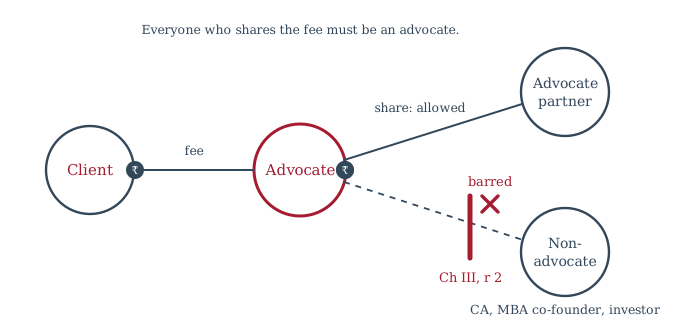
What the rule does not forbid is employing non-advocates. A firm may pay a salary to an accountant, a paralegal or an office manager, because a salary is a wage for work done, not a share of the fees. The line is crossed when the pay is tied to the fees: a percentage of billing, a profit share, a bonus calculated on what a client paid. A related rule forbids an advocate to let his name or services be used to make possible the unauthorised practice of law by any law agency,6 which is the rule broken when an advocate lends a name to a business run by non-lawyers that gives legal advice.
A partnership of advocates, the ordinary law firm, is plainly allowed. The rules say nothing about limited liability partnerships, but rule 2 applies to any arrangement for sharing remuneration, whatever its legal form, so every partner in a law firm LLP must be an advocate too. A private limited company cannot practise law at all, even one owned entirely by advocates, because the company would be the one practising, and a company is not an advocate.
A business that is not law: own it, do not run it
The third form of the question is different. A business that does not practise law is outside the Advocates Act, and a non-advocate may own and run it. The question is what an advocate who keeps practising may do in it. Section VII of the conduct rules, “Restriction on other Employments”, answers that, and it is stricter than most advocates expect.7
Rule 47 is the main restriction: “An advocate shall not personally engage in any business”. The same rule allows the advocate to be a sleeping partner in a firm doing business, if the State Bar Council is of the opinion that the nature of the business is not inconsistent with the dignity of the profession. Rule 48 does the same for companies. An advocate may be a director, or chairman of the board, with or without sitting fees, “provided none of his duties are of an executive character”, and “shall not be a Managing Director or a Secretary of any Company”. Rule 49 adds that an advocate cannot be a full-time salaried employee of anyone while practising.
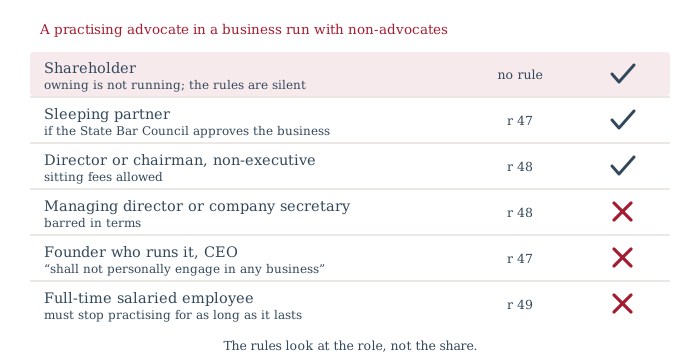
Put together, an advocate may hold shares in a private limited company with non-advocate co-founders, since nothing in the rules restricts ownership, and may sit on its board as a non-executive director. A private company needs at least two members and two directors,8 so the advocate can be one of each. What the advocate cannot be, while still practising, is the person who runs it: the managing director, the chief executive, the founder who signs the contracts and manages the staff. In a partnership firm doing business, the advocate can only be a sleeping partner, and only with the State Bar Council’s approval of the business.
There is one narrow exception for family businesses. An advocate who inherits a family business, or a share in one, may keep it, but may not personally take part in managing it.9 Work close to the profession is treated more generously. Reviewing Parliamentary Bills, editing law books, teaching, journalism and broadcasting are expressly permitted, and part-time employment is allowed with the State Bar Council’s consent.10
The Supreme Court has applied the full-time principle more than once. In Haniraj Chulani it upheld a Bar Council rule that refused enrolment to a doctor who wanted to go on practising medicine while practising law.11 In Satish Kumar Sharma it held that a full-time salaried law officer of a state electricity board could not be enrolled as an advocate, and that the enrolment already granted was invalid.12
The way out: suspend practice
An advocate who wants to run a business is not stuck. The rules let an advocate voluntarily suspend practice by informing the State Bar Council by registered post and surrendering the enrolment certificate. To resume, the advocate applies to the State Bar Council with an affidavit stating whether any disqualification under section 24A was incurred in the meantime, and the Enrolment Committee may then order the practice resumed.13 During the suspension, the advocate can be a managing director, a chief executive or a full-time employee like anyone else. The only thing given up is practice.
This is also the position of the many law graduates who work for legal-tech companies, legal publishers and in-house legal teams. A company may build software for lawyers, publish judgments or run a research database, none of which is the practice of law. An advocate it employs full-time must suspend practice for as long as the job lasts. If the company starts giving legal advice to the public, Balaji’s point about labels applies, and it becomes a business practising law without being entitled to.
Why the rules are written this way
The rule against sharing fees has a reason behind it. An advocate owes the client loyalty and the court candour, and is disciplined by the Bar Council if either fails.14 A non-advocate who takes a share of the fees owes neither duty and answers to no Bar Council, but has a financial interest in every decision the advocate makes about a case: whether to settle, how much to bill, which client to turn away. The rule keeps that interest out of the relationship between advocate and client. The restriction on running a business has a plainer reason: the rules assume that an advocate’s working time belongs to the profession.
Other jurisdictions have chosen differently. England and Wales has allowed “alternative business structures”, law firms with non-lawyer owners and managers, since the Legal Services Act 2007.15 India has not, and an Indian advocate who signs a partnership deed with a non-advocate to practise law commits misconduct, whatever any other country allows.
So, to answer the question as it is usually asked. Can an advocate start a law firm with a non-advocate? No, as a partner or as anything else that takes a share of the fees. Can an advocate start a private limited company with a non-advocate? Yes, if the company does not practise law and the advocate owns shares and sits on the board without running it. If the advocate wants to run it, practice has to be suspended first.
Filed under The Legal Profession
- Advocates Act 1961, s 29. Section 33 adds that no person may practise in any court or before any authority unless enrolled as an advocate. ↩
- ibid s 24(1). ↩
- ibid s 45. ↩
- Bar Council of India v A.K. Balaji, 2018 INSC 235, decided 13 March 2018 (Adarsh Kumar Goel and U.U. Lalit JJ). ↩
- Bar Council of India Rules, Part VI, Chapter III, r 2, made under section 49(1)(ah) of the Advocates Act 1961. ↩
- ibid Part VI, Chapter II, Section IV, r 37. ↩
- ibid Part VI, Chapter II, Section VII, rr 47 to 52. ↩
- Companies Act 2013, ss 3(1)(b) and 149(1)(a). ↩
- Bar Council of India Rules, Part VI, Chapter II, Section VII, r 50. ↩
- ibid rr 51 and 52. ↩
- Dr. Haniraj L. Chulani v Bar Council of Maharashtra and Goa, 1996 INSC 491, decided 8 April 1996. ↩
- Satish Kumar Sharma v Bar Council of Himachal Pradesh, 2001 INSC 2. ↩
- Bar Council of India Rules, Part VI, Chapter III, r 5. ↩
- Advocates Act 1961, s 35. See An Officer of the Court, Paid by the Client. ↩
- Legal Services Act 2007 (England and Wales), Part 5. ↩