Why Mothers Are Still Not Equal Guardians Under Hindu Law
In 1984, a woman applied to the Reserve Bank of India for relief bonds in her son’s name. She signed the form as his guardian. Her husband had signed it too, and neither of them thought the matter would take fifteen years to resolve.1
The Reserve Bank returned it. The application, it said, had to be made by the father, or, failing that, the mother would need a certificate of guardianship from a competent court. A married woman, living with her husband, applying jointly with him, on behalf of a child they were raising together, was told she would have to go to court to prove she was entitled to act for her own son.
That refusal produced Githa Hariharan v. Reserve Bank of India, 1999 INSC 66,2 which is remembered as the judgment that made Indian mothers guardians of their children. It is a good deal more complicated than that, and the complication is the interesting part.
The provision, and one word in it
Section 6(a) of the Hindu Minority and Guardianship Act, 1956 names the natural guardians of a Hindu minor. For a boy or an unmarried girl, it says, the natural guardian is “the father, and after him, the mother”.3 Section 19(b) of the Guardians and Wards Act, 1890 is drafted to the same effect.
Everything turned on those two words.
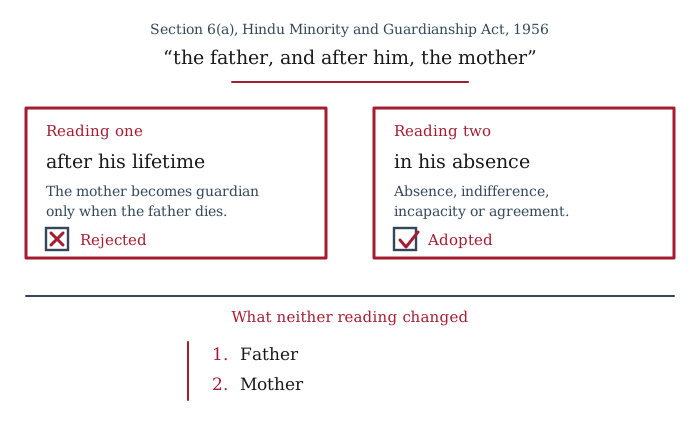
The Reserve Bank read “after him” the way it had always been read, and the way the words most naturally fall: after his lifetime. On that reading a mother is not a guardian at all while the father is alive. She is a guardian-in-waiting, and her authority over her own child is contingent on her husband’s death.
Githa Hariharan’s petition, heard together with one brought by Dr. Vandana Shiva on similar facts, argued that a provision of that kind could not survive Articles 14 and 15. It discriminated on the ground of sex and nothing else.4
What the Court actually did
The Supreme Court did not strike section 6(a) down. It read it down, which is a different thing and, for the argument that follows, the whole thing.
“After”, the Court held, does not mean after the father’s lifetime. It means in his absence, and absence is not confined to death. It covers a father who is physically absent, who is indifferent to the child, who is incapable of acting, who has by agreement left the child’s affairs to the mother, or who for any reason is unable or unwilling to take care of the minor. In any of those situations the mother is the natural guardian, and she is that in her own right, during his lifetime, without applying to anyone.5
The reasoning proceeded on three tracks.
The first was ordinary constitutional avoidance. Where a statute admits of two constructions, one of which would render it unconstitutional and the other of which would save it, a court takes the second. The narrow reading of “after” would have condemned the section; the wider reading rescued it.6
The second was the welfare of the child, which section 13 of the Act makes the paramount consideration. A construction that disabled a competent, present, caring mother from acting for her child, and required her to litigate for permission, could not be reconciled with a statute whose declared object is the child’s welfare.
The third, and the one most often quoted since, was international. The Court referred to India’s obligations under the Convention on the Elimination of All Forms of Discrimination Against Women and to the Beijing Declaration, and read the domestic provision in their light.7
On any view this was a real advance. A mother in Githa Hariharan’s position no longer has to prove her entitlement to act for her child, and the Reserve Bank’s form is not the law.
What it left standing
Now read the holding again, and notice what it does not say.
It does not say that a mother is an equal natural guardian. It says she is the natural guardian in the father’s absence. The father remains first. The mother remains second. What the Court altered was the trigger that moves her up the list, from his death to his absence, not the existence of the list.
The hierarchy survived the case that was brought to abolish it.
That has consequences which are not merely symbolic. A rule of primacy has to be applied by somebody, and when it is contested, the question becomes whether the father is really “absent” in the required sense. A mother acting during her husband’s lifetime is therefore exercising an authority that is, in principle, always open to challenge on the footing that he was present enough after all. She acts by exception, and an exception is a thing that has to be established. The father acts by default, and a default is a thing that has to be displaced. Those are not the same position, whatever the outcome in a particular case.
There is also the plain expressive point. A statute that ranks a child’s parents, and puts the mother second, says something, and it goes on saying it after 1999, because the words are unchanged. Reading down alters how a provision operates. It leaves the text exactly where it was, for the next person who opens the bare Act.
Why the Court stopped where it did
It is worth being fair about this, because the choice was not obviously wrong.
Reading down is the more restrained remedy, and restraint is a virtue in a court dealing with personal law. Striking down section 6(a) would have left a gap: if neither parent is designated the natural guardian, who is, and on what basis is a dispute resolved? Parliament, not a court, is equipped to design a replacement, to decide between equal joint guardianship, a welfare-based allocation, or some other scheme, and to make the consequential amendments across the Guardians and Wards Act and the rest.
A court that strikes down without a replacement can create more disorder than it cures. So the Court did the smaller thing, and did it well, and left the larger thing to the legislature.
The difficulty is what happened next, which is nothing.
Twenty-seven years of nothing
In 2015 the Law Commission of India returned to the subject in its report on reforms in guardianship and custody law. It recommended, in terms, that the superiority of the father be removed, that both parents be treated as equal natural guardians, and that the law make provision for joint custody.8 The recommendation has not been enacted.
So section 6(a) reads today exactly as it read in 1956. A litigant with the resources to find Githa Hariharan knows that “after” means “in the absence of”. Everyone else reads the section and finds a mother ranked below a father, which is what it says.
The courts have kept building around it. In ABC v. State (NCT of Delhi), 2015 INSC 4829, the Supreme Court held that an unwed mother could be appointed sole guardian without notice to the father, declining to make her disclose his identity, a decision that is difficult to square with any strong reading of paternal primacy, and which shows how much work the welfare principle is now doing. But each of these is a further exception. None of them touches the ranking.
The narrower lesson
There is a habit of citing Githa Hariharan as though it settled the question of guardianship equality in India. It did not. It settled a narrower and genuinely important question, whether a mother must wait for widowhood to act for her child, and it answered it correctly.
What it also did, unavoidably, was to relieve the pressure. A provision that is being applied in a constitutionally tolerable way is a provision nobody is urgently required to amend. The reading down that rescued section 6(a) in 1999 is the reason it has survived, unamended, for the twenty-seven years since. Saving a statute and entrenching it can be the same act.
That is not a criticism of the judgment so much as an observation about what judgments of that kind can and cannot achieve. A court can tell you what a word means. It cannot delete the word. Section 6(a) still ranks a child’s parents, and only Parliament can stop it doing so.
Filed under Women's Rights
- The petitioner and her husband applied jointly to the Reserve Bank of India for 9% Relief Bonds to be held in the name of their minor son, with the mother signing as his natural guardian. The application was returned with an intimation that it should be made by the father, or by the mother on production of a certificate of guardianship from a competent authority. ↩
- Githa Hariharan v Reserve Bank of India, 1999 INSC 66. ↩
- Hindu Minority and Guardianship Act 1956, s 6(a). The proviso to s 6 adds that the custody of a minor who has not completed the age of five years shall ordinarily be with the mother. ↩
- The petition of Dr. Vandana Shiva, raising the same question on different facts, was heard along with it. ↩
- The Court’s construction of “after” extends to the father’s absence from the care of the minor’s property or person for any reason whatever, including indifference, mutual understanding between the parents, physical absence, and incapacity. ↩
- The principle that a construction preserving constitutionality is to be preferred where the statutory language admits of it. ↩
- Convention on the Elimination of All Forms of Discrimination Against Women, 1979, to which India is a party; and the Beijing Declaration and Platform for Action, 1995. ↩
- Law Commission of India, Reforms in Guardianship and Custody Laws in India, Report No. 257 (May 2015). The Commission recommended a gender-neutral framework conferring equal and concurrent guardianship rights on both parents, amendments to the Hindu Minority and Guardianship Act 1956 and the Guardians and Wards Act 1890, and the introduction of joint custody as an option. ↩
- ABC v State (NCT of Delhi), 2015 INSC 482, judgment of 6 July 2015 (Vikramajit Sen and Abhay Manohar Sapre JJ.). The Court held it was not imperative for an unwed mother to notify the putative father of her petition for appointment as guardian. ↩