Indian Law Sets No Age for Hearing a Child in Custody Cases
At ten, an Indian child may walk into a bank and open an account in her own name, and operate it herself, without a guardian anywhere near it.1
At fifteen, if her parents separate and a court is deciding which of them she will live with, no statute requires anybody to ask her what she wants.
The usual complaint about Indian law and childhood is that it cannot settle on a number. That is true, and it has been said well by many people. But spend a while inside the statutes and a sharper pattern shows through, and it is not really about inconsistency at all.
Indian law is perfectly willing to fix an age. It fixes ages constantly, precisely, and with real administrative teeth, whenever the age is there to bind an institution. It fixes no age at all when the question is whether to listen to the child.
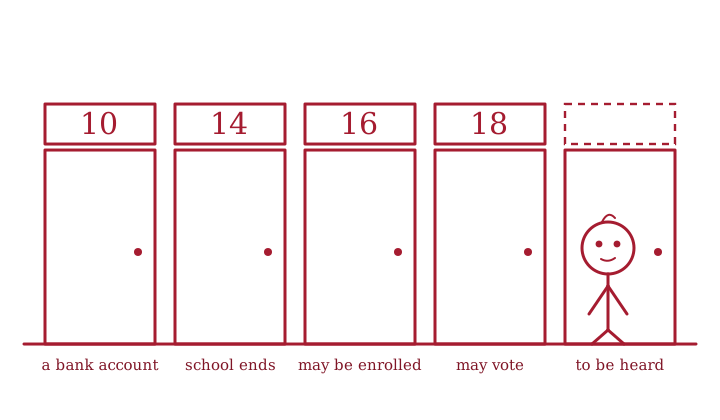
Ten, for money
The Reserve Bank told every commercial bank, urban co-operative bank and district central co-operative bank in the country, in April 2025, that minors above an age limit “not less than 10 years” may be allowed to open and operate savings and term deposit accounts independently, if they so desire.1 The circular repealed ten earlier instructions to get there, including the 2014 one that everybody still cites.
It is worth being precise about what this is. It is not a right that vests in a ten-year-old. It is a floor on the bank’s discretion: the bank sets the age, the amount and the terms according to its own risk-management policy, and the regulator simply forbids it from setting that age higher than ten. Which is the point. When the Reserve Bank wanted to constrain the conduct of a few thousand institutions, it reached for a number, and the number went into a circular that was binding within ten weeks.
Sixteen, for the army
India has told the United Nations, in a formal declaration deposited with the Optional Protocol on the involvement of children in armed conflict, that “the minimum age for recruitment of prospective recruits into Armed Forces of India (Army, Air Force and Navy) is 16 years”, and that an enrolled soldier is sent to an operational area only after turning eighteen.2
In practice the services recruit under the Agnipath scheme from seventeen and a half.3 You can see what that means in the recruiting paperwork rather than in any statute: an Army recruiting notification carries a consent certificate to be signed by a father or legal guardian, beginning “I am below 18 years and my parents give their consent”. The form exists because the situation it contemplates is ordinary.
Here is the part that surprised me. The Army Act 1950 fixes no minimum age of enrolment at all. Sections 13 to 15 require only that the recruit understands the questions put to him and consents to the conditions of service.4 The seventeen-and-a-half floor is executive policy. The sixteen is a declaration to a treaty body. Neither is in the Act that actually governs enrolment.
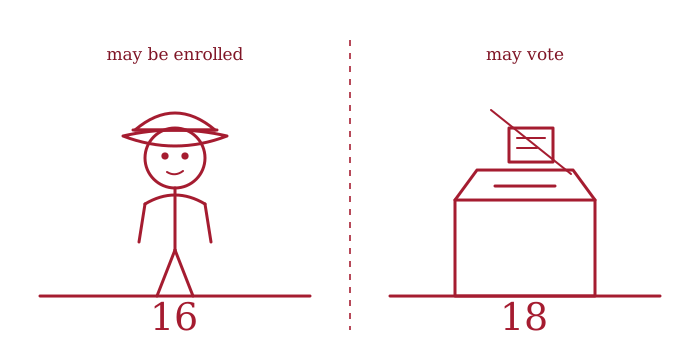
Eighteen, for the vote
The franchise arrives at eighteen, and it arrives twice over: Article 326 of the Constitution, as substituted by the Sixty-first Amendment with effect from 28 March 1989, and section 19 of the Representation of the People Act 1950.5 Both were changed from twenty-one on the same day.
So a person may be enrolled in the armed forces of India, in uniform, under military discipline, at seventeen and a half, and may not vote for the government that will decide where he is sent. The state is willing to accept his service before it is willing to accept his ballot.
I do not think this is scandalous, exactly. There are respectable arguments for a later voting age and for an earlier recruiting one. What is striking is that both numbers were chosen deliberately, defended in public, and written down. Somebody sat and decided.
And no age at all, for being heard
Now the custody court. Two adults are arguing about where a child will live. What does the law say about asking her?
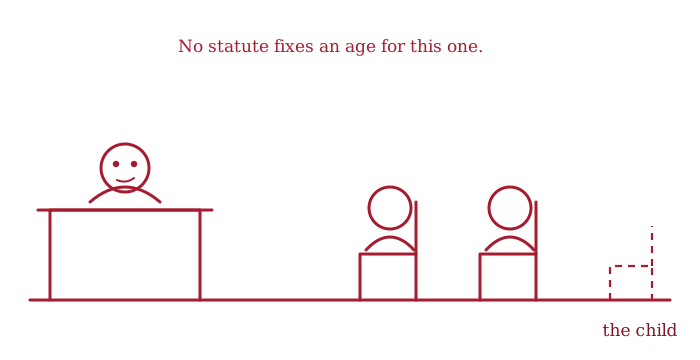
The Guardians and Wards Act 1890 says this, and only this: “If the minor is old enough to form an intelligent preference, the Court may consider that preference.”6 There is no age. There are two discretions stacked on each other, the court decides whether she is old enough, and then decides whether to consider what she says. Section 17(2) lists the factors the court must weigh: her age, her sex, her religion, the character and capacity of the proposed guardian. Her own view is not among them.
The Hindu Minority and Guardianship Act does contain an age, and it is five, but it fixes where a child under five ordinarily lives, not whether anyone asks her.7 The Hindu Marriage Act asks for custody orders to be made consistently with the children’s wishes “wherever possible”.8 Wherever possible is not an age. It is barely an obligation.
There is one place where Indian law states the principle properly. Section 3(iii) of the Juvenile Justice Act 2015 says every child has a right to be heard and to participate in all processes and decisions affecting his interest, with the child’s views taken into consideration with due regard to age and maturity.9 That is almost word for word Article 12 of the Convention on the Rights of the Child, which India acceded to on 11 December 1992 and which requires that a child be given the opportunity to be heard in any judicial proceeding affecting her.10
But section 3 binds the Central Government, the State Governments, the Board and the Committee while implementing that Act. It does not reach a family court deciding between two parents. The one clean statement of the child’s right to be heard in Indian law sits in a statute that does not govern the proceeding where she most needs it.
What the pattern is
Five in the Hindu Minority and Guardianship Act. Ten in a Reserve Bank circular. Fourteen where the right to education stops.11 Sixteen in a declaration to the United Nations. Eighteen in the Constitution. Seven and twelve in the criminal code, unchanged since 1860 and carried into the Bharatiya Nyaya Sanhita in the same words.12
Every one of those numbers exists because somebody needed to instruct an institution, a bank, a recruiting office, an electoral registration officer, a magistrate, a school. Fixing an age is what you do when you intend to hold somebody to something. It is an administrative act before it is a philosophical one.
And that is why the gap in the custody court is not an oversight. No age was fixed there because fixing one would have bound the court, and nobody wished to bind the court. Discretion was thought kinder. It usually is, for the person exercising it.
The child in that courtroom is old enough, on the state’s own reckoning, to hold a bank account in her own name and move her own money. She is four years from being old enough to enlist. The law has managed a number for both of those. It has never managed one for her being asked where she would like to live.
Filed under Child Rights
- Reserve Bank of India, “Opening of and operation in deposit accounts of minors”, RBI/2025-26/26, DOR.MCS.REC.17/01.01.003/2025-26, 21 April 2025, issued under ss. 35A and 56 of the Banking Regulation Act 1949; banks to comply by 1 July 2025. The circular repeals ten earlier instructions, including DBOD.No.Leg.BC.108/09.07.005/2013-14 dated 6 May 2014. ↩
- Declaration by India under art. 3(2) of the Optional Protocol to the Convention on the Rights of the Child on the involvement of children in armed conflict; signed 15 November 2004, ratified 30 November 2005. UN Treaty Collection, Ch. IV-11-b. ↩
- Ministry of Defence, Press Information Bureau Release ID 1834227, 15 June 2022 (“the eligible age will be in range from 17.5 to 21 years”); the upper limit was raised to 23 as a one-time waiver for the 2022 cycle only, Release ID 1834658, 17 June 2022. ↩
- Army Act 1950, ss. 13–15. Cadets at the National Defence Academy, who may begin training at about sixteen and a half, are trainees rather than enrolled personnel. ↩
- Constitution of India, art. 326, as substituted by the Constitution (Sixty-first Amendment) Act 1988, s. 2, with effect from 28 March 1989; Representation of the People Act 1950, s. 19, as amended by Act 21 of 1989, s. 4, with effect from the same date. The Representation of the People Act 1951 sets no age. ↩
- Guardians and Wards Act 1890, s. 17(3); the factors the court must regard are in s. 17(2). ↩
- Hindu Minority and Guardianship Act 1956, s. 6(a), proviso. ↩
- Hindu Marriage Act 1955, s. 26. ↩
- Juvenile Justice (Care and Protection of Children) Act 2015, s. 3(iii); the section binds the bodies listed in s. 3 while implementing that Act. See also s. 61(1)(b), on the wishes of the child in adoption proceedings. ↩
- Convention on the Rights of the Child 1989, art. 12, 1577 UNTS 3. India acceded on 11 December 1992, with a declaration concerning the progressive implementation of art. 32. ↩
- Right of Children to Free and Compulsory Education Act 2009, ss. 2(c) and 3(1); Constitution of India, art. 21A. ↩
- Bharatiya Nyaya Sanhita 2023, ss. 20 and 21, reproducing ss. 82 and 83 of the Indian Penal Code 1860. Note that s. 2(3) of the same Sanhita defines “child”, for the whole of it, as a person below eighteen. ↩