Why a Child’s Custody Hearing Should Be on the Record
On 12 August 2025, a fifteen-year-old girl went over the first-floor railing of the Madras High Court, minutes after a Bench decided where she would live. She survived, injured.1
What the reports agree on is this. Her father had brought a habeas corpus petition to recover her from her mother, who had divorced him, moved to the Andaman Islands and remarried. Brought before the court, the girl said what she wanted: to go with her mother. The judges, “after perusing a confidential report submitted by the mediation centre”, concluded it would not be safe, declined, and directed that she be placed in a state children’s home. The hearing ended, the order was passed, and as the police walked her along the corridor she went over the edge.1
What the reports do not agree on is why. The Hindu and Law Trend quote an eyewitness advocate who thought it “appears to be an accident that occurred during the bid to escape from the police and not a suicide attempt”. The news agency ANI reported a girl “distressed by the decision” who “attempted suicide”. I cannot tell you which is true, and I will not pretend to.
But notice what is not in dispute, because it is the whole of the matter. She told the court where she wanted to go. What overrode her was a report she was never shown. And within minutes of an order she had no way to answer, a child was over a railing. Whether she meant to fall, no one can now say, and that no one can say is itself the indictment.

What the record keeps, and what it does not
A custody court reaches the child’s own voice through channels that are, by design, closed. Proceedings may be held in camera, and must be, if either party asks.2 The welfare or mediation report that so often decides the case comes to the judge in confidence. And where the judge wishes to hear the child directly, the practice is to do it privately, away from the courtroom.
None of that is wrong in itself. A child should not be cross-examined in open court between her warring parents. The problem is not the privacy. It is that the privacy leaves no trace.
The contrast is written into the Family Courts Act itself. The Act tells the judge exactly what to do with a witness: “the Judge, as the examination of each witness proceeds, shall, record or cause to be recorded, a memorandum of the substance of what the witness deposes, and such memorandum shall be signed by the witness and the Judge and shall form part of the record.”3 A signed note, on the record, of everything a witness says. For the child’s own account of where she wants to live, and for the confidential report that may outweigh it, the Act requires nothing of the kind.
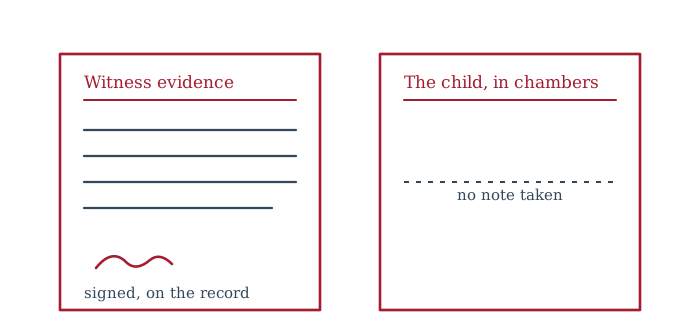
The conversation with no minute
When a court does hear the child directly, look at how the highest court in the country records it. In Ruchi Majoo v Sanjeev Majoo, 2011 INSC 395, deciding the custody of a boy, the Supreme Court wrote: “In the course of the hearing of the case, we had an occasion to interact with the minor in our chambers.” And later: “From what we gathered in the course of an interactive session with the minor, we concluded that the minor has been thoroughly antagonized against the respondent father.”4
The conclusion is on the page. The conversation is nowhere. We are told what the court took from the meeting, but not what the child said, nor what was asked, nor how. This is not a criticism peculiar to that case; it is the ordinary form of the thing. The Supreme Court has faulted a trial court for failing to ascertain a child’s wishes at all;5 but a wish ascertained in a room with no record is, on appeal, indistinguishable from a wish never ascertained. There is nothing to review.
Three people are shut out by that silence. The parent who lost cannot answer an impression he never saw formed. The appeal court cannot test a finding that rests on an unrecorded exchange. And the child cannot confirm that what she said is what the court heard.
What “heard” has to mean
India has bound itself, twice over, to hear the child. Article 12 of the Convention on the Rights of the Child guarantees the child the right to be heard in any judicial proceeding affecting her, her views “being given due weight in accordance with the age and maturity of the child”.6 The Juvenile Justice Act puts it in domestic terms: “Every child shall have a right to be heard and to participate in all processes and decisions affecting his interest.”6
Read carefully, the right is not only to speak. It is to have what one says given due weight. Weight is a thing that can be assigned honestly or not, and the only way to know which is to see it done. A weighing performed in private, recorded nowhere, cannot be checked by anyone, not the parties, not a higher court, not the child herself. A right to be heard that leaves no trace of the hearing is not obviously different, from the outside, from no hearing at all.
It has already been solved
None of this requires inventing anything. England and Wales worked it out fifteen years ago. Under the Family Justice Council’s guidelines for judges meeting children, if a judge decides to meet a child, the court must settle in advance “by whom a minute of the meeting shall be taken, how that minute is to be approved by the Judge, and how it is to be communicated to the other parties”.7 The judge tells the child at the outset that he “cannot hold secrets”, and that what the child says will, barring the exceptional, be passed to the parents. The meeting “is not for the purpose of gathering evidence”; the parties may respond to what was said; and a judge should “never see a child alone”.
That framework answers the one serious objection to recording: that a child will speak candidly only in confidence, and it answers it honestly. It does not buy candour with a promise of secrecy the court cannot keep, since whatever the child says may end up shaping an order her parents will read anyway. It tells her the truth at the start: this will be written down, and it will be shared. What is gained is that the decision built on her words becomes reviewable, and she can see that she was heard.
The same failure, from the other side
A month before the girl went over the railing at Madras, the Supreme Court did the opposite thing and produced the same harm. As the Times of India reported, the Court recalled its own order granting a father custody of a twelve-year-old after the boy suffered a mental breakdown, accepting that his deterioration was “a consequence of judicial order changing custody”, and describing the case as one of how courts should not decide custody “without interacting with the minor”.8
One court heard the child and set her aside on a report she could not see. The other did not hear the child at all. The two failures look like opposites and are the same failure: the child’s place in her own case is settled somewhere no one can later examine.
A custody order is close to the most consequential thing a court does to a person, and it is done to someone too young to appeal it in any real sense. That it can turn on a conversation no one may repeat, and a report no one may read, is not a small procedural untidiness. Recording the meeting, minuting the report, giving both to the parties; none of it turns the child into a witness or the chamber into a courtroom. It only makes the decision answerable. At Madras, a girl told the court what she wanted, was refused on a report she never saw, and had, in the end, nothing left to answer it with.
Filed under Child Rights
- “Girl injured after jumping from High Court building”, The Hindu, 13 August 2025; “15-Year-Old Girl Jumps from Madras High Court Building After Custody Hearing, Injured”, Law Trend, 13 August 2025. The Hindu and Law Trend quote an eyewitness advocate that it “appears to be an accident … and not a suicide attempt”; a separate ANI report (carried by Rediff) framed it as an attempted suicide by a girl “distressed by the decision”. The accounts differ on cause; the child survived. ↩
- Family Courts Act 1984, s. 11 (“the proceedings may be held in camera if the Family Court so desires and shall be so held if either party so desires”). ↩
- Family Courts Act 1984, s. 15. The only record obligation in the Act attaches to a witness’s evidence, not to the court’s ascertainment of the child’s wishes or to an expert or mediation report. ↩
- Ruchi Majoo v Sanjeev Majoo, 2011 INSC 395. ↩
- Nil Ratan Kundu v Abhijit Kundu, 2008 INSC 920 (Supreme Court, 2008), where the Court treated the failure to ascertain the child’s wishes as a defect; see also Vivek Singh v Romani Singh, 2017 INSC 130, on interacting with the child to assess her wishes. ↩
- Convention on the Rights of the Child 1989, art. 12; Juvenile Justice (Care and Protection of Children) Act 2015, s. 3(iii) (“Principle of participation”). ↩
- Family Justice Council (England and Wales), Guidelines for Judges Meeting Children who are subject to Family Proceedings, April 2010, guidelines 5 and 6. ↩
- “Supreme Court reverses custody order after child has a mental breakdown”, The Times of India, 17 July 2025, reporting the order and quoting the Court; the primary judgment is not reproduced here. ↩