The UN Veto Cannot Be Abolished Without the Veto Powers’ Consent
Open the Charter of the United Nations today, at Article 23, and read the list of the states that hold permanent seats on the Security Council. One of them is “the Union of Soviet Socialist Republics”.1
That country dissolved in December 1991. The founding text of the organisation still names it, more than three decades later, as though nothing had happened. This is not a museum copy. It is the operative Charter, on the United Nations’ own website, unamended.
How a document can go on naming a state that no longer exists, and why nobody has corrected it, turns out to be the whole story of the veto in miniature.
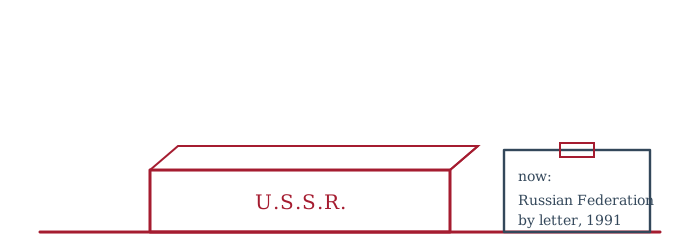
The seat that changed hands by letter
When the Soviet Union broke apart, its permanent seat did not go to a vote. There was no Charter amendment, no resolution of the General Assembly, no election. In December 1991 the President of Russia wrote to the Secretary-General to say that Russia would continue the Soviet Union’s membership, including its seat on the Security Council. The letter was accepted, and that was that.2
It was, in strict legal terms, an extraordinary thing to do by correspondence. A permanent seat is the highest privilege the international order confers, and it passed from one state to another on the strength of a note. The point is not that this was wrong, continuity was probably the least destabilising option available in 1991. The point is what it reveals: the identity of the permanent five is not really governed by the Charter at all. The text says one thing; the practice does another; and the text is never brought into line, because bringing it into line is harder than living with the gap.
What the veto actually is
The veto is not a clause headed “veto”. It is a consequence of how Article 27 counts votes. A substantive decision of the Security Council requires “an affirmative vote of nine members including the concurring votes of the permanent members”.3 Nine of fifteen, and all five of the permanent members among them. A single permanent member voting no defeats the decision, however many others are in favour.
The text says “concurring votes”, which ought to mean that a permanent member has to vote yes for anything to pass. In practice it never meant that. From the earliest years, an abstention or an absence by a permanent member was treated as not blocking the decision, and that reading has been settled law for decades, the International Court of Justice confirmed it as established practice in 1971.4 So a permanent member has to raise its hand against a resolution to kill it. Sitting on its hands is not enough. This is the one place where the veto has been quietly softened, and it was softened by practice, not by amendment, which is the pattern again.
The first veto was cast on 16 February 1946, a fortnight into the Council’s existence.5 The Soviet Union, and after it Russia, has used the power more than any other member. But a tally of who has used it most misses the deeper feature, which is not how often the veto is used but what it protects.
The lock that holds its own key
Here is the provision that does the real work, and it is not Article 27. It is Article 108. An amendment to the Charter comes into force only when it has been adopted by two-thirds of the General Assembly and ratified by two-thirds of the member states: including all the permanent members of the Security Council.6
Read that last clause slowly. The Charter cannot be amended over the objection of any one permanent member. Which means the five states that hold the veto also hold a veto over any change to the Charter, including any change to the veto. To take the veto away from them, you would need an amendment. To pass that amendment, you would need their consent. They will not consent to their own disarmament, and they do not have to.
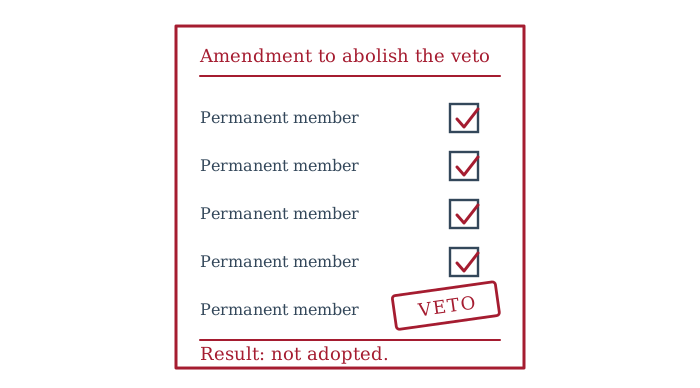
This is what makes the veto different from an ordinary excess of power. Most entrenched privileges can at least be attacked through the rules. This one is written into the amendment rule itself. It is a lock whose key is held on the inside, by the very people the lock is meant to constrain. The veto’s most reliable achievement is not any particular resolution it has blocked. It is its own survival.
The workarounds that concede the point
Everything the United Nations has done about the veto has therefore gone around the Council rather than through it, because through it is closed.
In 1950, faced with deadlock, the General Assembly gave itself the power to meet and recommend collective action when the Council is paralysed by a lack of unanimity among the permanent members, the Uniting for Peace resolution.7 In 2022, it went further, adopting a standing mandate that the Assembly will convene automatically after any veto is cast, to debate it, and to make the vetoing state explain itself.8 Both are real. Neither touches the veto. They build a second room for the conversation the Council will not have, because the door to the first room cannot be opened from outside.
That is the honest measure of the thing. Not that the veto is used too often, or unfairly, though both charges can be made. It is that the veto is the one feature of the postwar settlement that was designed so that it could never be settled again without the agreement of those it favours. A country that ceased to exist in 1991 is still named in the text, and the text cannot easily be corrected, for the same reason the veto cannot be removed: the pen that would make the correction is held by the five, and they have no reason to lift it.
- Charter of the United Nations, art. 23(1). The Article names “The Republic of China, France, the Union of Soviet Socialist Republics, the United Kingdom of Great Britain and Northern Ireland, and the United States of America” as the permanent members. Text as published by the United Nations, un.org. ↩
- Following the dissolution of the USSR, Russia continued the Soviet Union’s United Nations membership and its permanent seat by a letter from President Yeltsin to the Secretary-General dated 24 December 1991; no Charter amendment or vote was involved. ↩
- Charter of the United Nations, art. 27(3). Article 27(2) requires nine affirmative votes for procedural matters. The present figure of nine (of fifteen) reflects the amendment to Articles 23 and 27 adopted in 1963 and in force on 31 August 1965, which enlarged the Council from eleven members to fifteen; the original text required seven. ↩
- The practice that a permanent member’s abstention or absence does not prevent adoption was confirmed as established by the International Court of Justice in its advisory opinion Legal Consequences for States of the Continued Presence of South Africa in Namibia, 1971. ↩
- The first veto was cast on 16 February 1946. Current figures are maintained by the United Nations Dag Hammarskjöld Library, Security Council, Veto List. ↩
- Charter of the United Nations, art. 108. ↩
- General Assembly Resolution 377 A (V), “Uniting for Peace”, 3 November 1950. ↩
- General Assembly Resolution 76/262, 26 April 2022, establishing a standing mandate for a General Assembly debate when a veto is cast in the Security Council. ↩