Why a Social Media Ban for Children Would Fail the Constitution
The idea is in the air, and gaining ground. In its 2026 budget, the Karnataka government announced that it would ban social media for children under sixteen; a member of Parliament has introduced a bill that would do the same nationally.1 A High Court has urged the Centre to consider a law like Australia’s; the Supreme Court, asked to impose a ban itself, declined and sent the petitioners to Parliament.2 The mood is protective, and the instinct is understandable. But before India reaches for a ban, it is worth being clear about three things: it has not enacted one, it does not need one, and it could not lawfully have the blanket version now being urged on it.
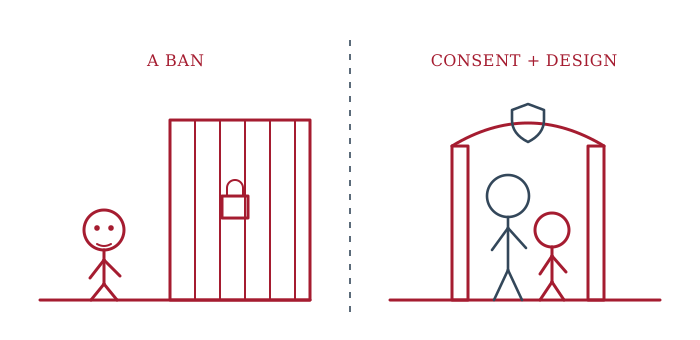
Start with what India actually has, because the debate keeps forgetting it. The Digital Personal Data Protection Act 2023 does not ban a child from anything. It requires a platform to obtain “verifiable consent of the parent” before processing a child’s data, and it forbids “tracking or behavioural monitoring of children or targeted advertising directed at children”.3 The 2025 Rules build the machinery for that consent.4 This is a consent-and-design regime: a parent at the gate, and hard limits on what may be done to the child inside. Parliament, given the choice, has already picked the gentler tool.
Why a ban would fail the proportionality test
Speech on the internet is protected speech. The Supreme Court has held that “the freedom of speech and expression through the medium of internet is an integral part of Article 19(1)(a) and accordingly, any restriction on the same must be in accordance with Article 19(2)”.5 And Article 19(1)(a) protects not only the speaker but the listener: the right “to receive information is a species of the right of freedom of speech and expression”.6 A ban on a whole platform silences both at once, everyone the child would have spoken to, and everything she would have read.
A restriction of that kind has to pass the proportionality test. In the same judgment the Court set it out in four parts: the measure must serve a legitimate goal; it must be a suitable means of furthering that goal; there must not exist “an equally effective but lesser restrictive alternative remedy”; and it must not have a disproportionate impact on the right-holder.7 The third limb is where a ban dies.
The necessity test asks whether a less restrictive measure would do the same work. Here the answer is not hypothetical. The less restrictive measure already exists, on the statute book, enacted by the same Parliament: verifiable parental consent, no behavioural tracking, no targeted advertising to children. You cannot argue that a blanket prohibition is necessary to protect children when your own law already protects them by a narrower route. The existence of the consent regime is, by itself, close to fatal to the constitutional case for a ban.
There is an Article 14 point folded into this. The Supreme Court has held that legislation which is “excessive and disproportionate” is for that reason manifestly arbitrary.8 A rule that treats a seventeen-year-old and a seven-year-old identically, and bars both from the same square that carries news, homework help, political argument and the company of their friends, is over-broad in exactly that way.
Can a State do this at all?
A ban announced by a State, as Karnataka’s was, meets a prior question that a national ban would not, and for a State it may be the shorter answer: whether it can legislate here in the first place. It probably cannot.
Communications are the Union’s subject. The Seventh Schedule places “posts and telegraphs; telephones, wireless, broadcasting and other like forms of communication” in the Union List, and Article 246 gives Parliament the exclusive power to make law on List I, a power the Article opens by overriding the State List.9 Social media is a like form of communication if anything is, and the Supreme Court has long treated the electronic spectrum as public property to be regulated by a central authority.
Parliament has in any case already occupied the ground. The Information Technology Act 2000 extends to the whole of India and, with its Intermediary Rules, governs social media platforms and the safe harbour they depend on; the Digital Personal Data Protection Act 2023 governs children’s data nationally.10 A State law that banned or licensed those platforms would trench on a Union subject, and to the extent it overlapped a central law it would fall to it, the Constitution makes the Union law prevail and the State law void to the extent of the inconsistency.
A State will reply that its real subject is public order, or crime, both open to it, and that a child-safety or fake-news law is in substance about harm and not about the medium. That is the framing Karnataka has used. But substance, not the label, decides competence, and the Concurrent List’s own criminal-law entry expressly excludes offences that touch a Union subject. A State may punish an act. It cannot ban the platform. The communications layer stays with the Union, which means the ban most likely to be enacted first is also the one least likely to survive.
The child is a speaker, not only a risk
Underneath the doctrine is a question about how the law sees a child. A ban sees a hazard to be removed from the room. The instruments India has ratified see something else.
Article 13 of the Convention on the Rights of the Child gives the child “the right to freedom of expression”, including the freedom to “seek, receive and impart information and ideas of all kinds” through “any … media of the child’s choice”, subject only to restrictions that are provided by law and necessary.11 The Committee on the Rights of the Child, interpreting the Convention for the digital age, was specific: children’s access to the digital environment should be restricted “only when it is provided by law and is necessary”, safety tools “should not be used to restrict children’s access to information … only to prevent the flow of harmful material”, and guidance should favour the child’s “emerging autonomy” over “prohibition or control”.12
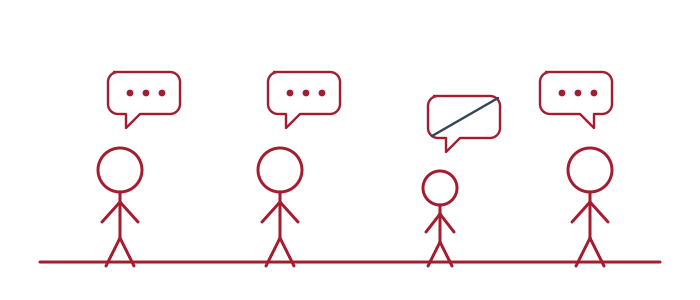
This is the same principle that runs through how a court is meant to treat a child in a custody case, or a legislature deciding when childhood ends: the child has a voice, and the law’s job is to weigh it, not to switch it off. A ban switches it off. It is protection that works by silencing the person it protects, and silence imposed for someone’s good is still silence.
Why copying Australia is not the answer
The model being urged on India is Australia’s. Its 2024 law requires platforms to “take reasonable steps to prevent age-restricted users having accounts”, an age-restricted user being a child under sixteen, on pain of very large fines.13 There is no parental-consent pathway: a parent cannot let a fifteen-year-old on. It is prohibition, flat.
Two things are wrong with importing it. The first is that the blanket approach is failing wherever it meets a real free-speech guarantee. In the United States, a federal court permanently struck down Arkansas’s social media age law, holding that it “forecloses access to social media for those minors whose parents do not consent”; Florida’s equivalent has spent years in split-court litigation.14 Australia can legislate this way partly because it has no entrenched constitutional free-speech clause of the kind India and the United States both have. India does. That difference is the whole point.
The second is that a constitution is not a menu. When the Madras High Court admired Australia’s law, and when a bill borrows its number, what is being skipped is the question India’s own Constitution insists on: is this the least restrictive means? Australia never had to ask it. India cannot avoid it. Most of the democratic world, in fact, did not choose the ban, the European Union, the United Kingdom, France and the United States all built their protections around age assurance, parental consent and safety-by-design.15 Australia is the outlier being sold as the template.
India has already done the harder and better thing. It has a regime that keeps a parent at the gate and forbids the tracking and targeting that actually harm children, without shutting a single child out of the public square. To abandon that for a ban, because another country reached for one, would fail the proportionality test its own Court has laid down, and would silence the very people it claims to protect. Protection that begins by taking away a child’s voice has misunderstood what it is protecting.
Filed under Cyber Law
- Karnataka’s Chief Minister announced the under-sixteen ban in the State budget speech of 6 March 2026; as of this writing it is a stated intention, not enacted law and not a bill introduced in the Legislative Assembly (“Karnataka proposes to ban social media for children under 16”, The Hindu, 6 March 2026). It should not be confused with the Karnataka Misinformation and Fake News (Prohibition) Bill 2025, which contains no age restriction. Separately, the Social Media (Age Restrictions and Online Safety) Bill, a private member’s bill introduced by L.S.K. Devarayalu MP (Telugu Desam Party) in January 2026, not government legislation and not enacted, would bar those under sixteen from holding an account (Reuters, 31 January 2026). ↩
- The Madras High Court, in S. Vijayakumar v Union of India, suggested the Union consider a law along Australian lines; this was an observation, not a binding direction, and it was widely reported at the time. Separately, the Supreme Court declined a public interest petition seeking a statutory ban on social media for children below thirteen, holding the question to lie in the policy domain and directing the petitioner to Parliament (B.R. Gavai and A.G. Masih JJ, 4 April 2025). ↩
- Digital Personal Data Protection Act 2023, s. 9(1) and (3); “child” is a person under eighteen, s. 2(f). ↩
- Digital Personal Data Protection Rules 2025, r. 10 (verifiable consent for processing of a child’s personal data), notified 13 November 2025. ↩
- Anuradha Bhasin v Union of India, 2020 INSC 31. ↩
- Secretary, Ministry of Information and Broadcasting v Cricket Association of Bengal, Supreme Court of India, 9 February 1995. ↩
- Anuradha Bhasin (n 5), stating the four-pronged proportionality test: legitimate goal, rational connection, necessity (“an equally effective but lesser restrictive alternative remedy”) and balancing. See also K.S. Puttaswamy v Union of India, 2017 INSC 801. ↩
- Shayara Bano v Union of India, 2017 INSC 785 (manifest arbitrariness includes what is “excessive and disproportionate”). ↩
- Constitution of India, Seventh Schedule, List I (Union List), Entry 31 (“Posts and telegraphs; telephones, wireless, broadcasting and other like forms of communication”); art. 246(1), giving Parliament exclusive power over List I. On the electronic spectrum as public property for central regulation, see Cricket Association of Bengal (n 6). ↩
- The field is occupied by central law: the Information Technology Act 2000 (which extends to the whole of India, and with the Intermediary Rules 2021 governs social media platforms and their safe harbour under s. 79) and the Digital Personal Data Protection Act 2023. A State’s counter-anchors: “Public order” and “Police” (List II, Entries 1 and 2), are limited by List III (Concurrent) Entry 1, which excludes offences relating to a List I subject, and by art. 254, under which a central law prevails over a repugnant State law. ↩
- Convention on the Rights of the Child 1989, art. 13. ↩
- Committee on the Rights of the Child, General Comment No. 25 (2021) on children’s rights in relation to the digital environment, UN Doc CRC/C/GC/25, paras 50, 56 and 86. ↩
- Online Safety Amendment (Social Media Minimum Age) Act 2024 (Cth), inserting Part 4A into the Online Safety Act 2021 (Cth); s. 63D (platform duty) and s. 5 (“age-restricted user”). ↩
- NetChoice v Griffin, US District Court, W.D. Arkansas, 31 March 2025 (Arkansas Social Media Safety Act permanently enjoined on First Amendment grounds); the Florida law (HB 3 of 2024) remains in contested litigation. ↩
- EU Digital Services Act (Regulation (EU) 2022/2065), art. 28; UK Online Safety Act 2023 (age assurance); France, Loi n° 2023-566 (digital majority at fifteen, with parental consent); US Children’s Online Privacy Protection Act (parental consent for under-thirteens). ↩