Mental Cruelty Is Recognised in Law but Almost Impossible to Prove
Indian law has treated mental cruelty as cruelty since 1988. The doctrine is settled, the categories have been mapped, and no court now needs persuading that a marriage can be destroyed without a hand being raised.
What the law has never solved is how to prove it. And in the cases where the question matters most, the only person who could describe what happened is dead before anybody asks.
How the concept was built
Cruelty is a ground for divorce under section 13(1)(ia) of the Hindu Marriage Act, and the Act does not define it. That omission is deliberate, and the Supreme Court has treated it as a feature rather than a gap.
In Shobha Rani v. Madhukar Reddi, 1987 INSC 329, the Court held that cruelty may be mental or physical, that it needs no definition because it describes human conduct in all its variety, and, importantly, that a persistent demand for dowry is itself cruelty, without more.1 It also held that intention is not an essential ingredient. Conduct can be cruel without being designed to be.
Six years later, in V. Bhagat v. D. Bhagat, 1993 INSC 374, the Court supplied a working formulation: mental cruelty is conduct which inflicts on the other party such mental pain and suffering as would make it impossible for that party to live with the other.2 It added a caution that has done a lot of work since: what amounts to cruelty depends on the social background, education and circumstances of the parties, so the standard is contextual rather than absolute.
The consolidation came in Samar Ghosh v. Jaya Ghosh, 2007 INSC 338, where a three-judge Bench set out illustrative instances of mental cruelty.3 The list is expressly not exhaustive, and its contents are worth noticing: sustained reprehensible conduct; studied neglect and indifference; continued unprovoked contempt; sustained abusive and humiliating treatment; conduct causing sustained ill health or mental distress; and, at the far end, a marriage that has become a fiction sustained only by the bond of law.
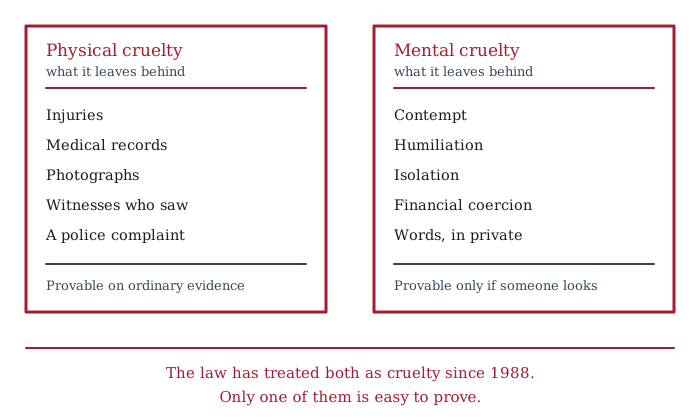
Read that list and notice what is absent from it. Not one of those categories leaves a bruise, a scan, or a hospital record.
The same word, a different courtroom
All of that was built in the matrimonial jurisdiction, where the question is whether a marriage should end, the remedy is exit, and the standard of proof is the balance of probabilities.4
The criminal law borrows the concept and asks it to do something much harder.
Section 85 of the Bharatiya Nyaya Sanhita punishes a husband or his relative who subjects a woman to cruelty, and section 86 defines it. The definition has two limbs: wilful conduct of a nature likely to drive the woman to suicide or to cause grave injury or danger to her life, limb or health, and the section says expressly mental or physical health, or harassment to coerce her or her relatives into meeting an unlawful demand for property.5
So mental cruelty is not smuggled into the criminal law by analogy. It is written into the text. The difficulty is not recognition. It is proof, and the standard is now beyond reasonable doubt.
Where the woman has died, the prosecution usually runs on section 108, abetment of suicide, and that raises a further problem. Abetment requires instigation, and the Supreme Court has been consistent that instigation means a positive act, and that words spoken in anger, without intending the consequence, do not amount to it.6 A course of contemptuous conduct over months is precisely the kind of thing that satisfies the matrimonial test easily and the criminal test with difficulty.
What the legislature did about it
Parliament understood the evidentiary problem and dealt with it in the only way available: by shifting the burden.
Where a married woman dies by suicide within seven years of marriage, and it is shown that her husband or his relatives subjected her to cruelty, the court may presume that the suicide was abetted.7 Where a woman dies otherwise than in normal circumstances within seven years, and it is shown that soon before her death she was subjected to cruelty or harassment in connection with a demand for dowry, the court shall presume dowry death.8
The difference between those two words is the difference between a discretion and a command, and in practice it is the difference between a hard prosecution and a straightforward one. It is also why the framing of a dowry allegation matters so much more than it might appear to.
The case now before the courts
Which brings me to why I am writing this now.
On 14 August 2026 the Central Bureau of Investigation filed its chargesheet in the death of Twisha Sharma, a 33-year-old former model and actor found dead at her matrimonial home in Bhopal on 12 May 2026, five months after her marriage. The accused are her husband, an advocate, and her mother-in-law, a retired district judge.9 Both are in judicial custody. Nothing has been tried, nothing has been found, and everything that follows is an allegation which the accused deny.
I am writing about it not to say what happened, which is for a court, but because the chargesheet is an unusually explicit document about what mental cruelty is alleged to look like from the inside.
What the agency is reported to allege, over roughly six months, includes: repeated derogatory remarks about her character; a mother-in-law who is said to have instigated her son and shielded him from complaint; harassment during a period when she was caring for her father through a heart condition; pressure and questioning over an unplanned pregnancy; demands that she transfer twenty lakh rupees from her demat account to his; and mockery of her professional setbacks, including the taunt that she did not even know how to speak English.10
Set that list beside Samar Ghosh. Continued unprovoked contempt. Sustained abusive and humiliating treatment. Studied indifference at a moment of family crisis. They map almost item for item, which is not a coincidence; it is what the category was always describing.
What is unusual is not the allegation. It is the documentation.
The thing this case actually shows
Allegations of this kind are made in thousands of cases a year and almost never appear in this form. They appear as a sentence: she was subjected to mental and physical cruelty, unsupported, unparticularised, and therefore nearly impossible to test either way.
The difference here is that somebody did the work. Reports indicate the investigation involved forensic extraction of phones, footage from the home, financial records and a second post-mortem by a team from AIIMS.11 Six months of private conduct were reconstructed from the traces it happened to leave.
That is what mental cruelty looks like when it is investigated properly. It is also, plainly, not what most such cases receive. This one has the attention it does partly because of who the accused are, and it is worth being honest that the ordinary case does not get a central agency, a second autopsy at a national institute, or a thousand-page chargesheet.
The doctrine is not the bottleneck. Shobha Rani settled that cruelty need not be physical in 1988. Samar Ghosh catalogued the forms in 2007. Section 86 of the Sanhita spells out mental health in terms. A court hearing a properly investigated case has every tool it needs.
The bottleneck is that mental cruelty happens in private, leaves no marks, and is testified to by a person who is frequently no longer alive to testify. Everything then depends on whether anyone thought it worth reconstructing, and that is an investigative choice, not a legal one.
The objection, and what it is worth
There is a counter-argument that has to be met rather than ignored, because it is made constantly and it is not baseless.
The provision that became section 85 has a long history of being invoked against whole families indiscriminately. The Supreme Court has said so, repeatedly and in strong terms, directing that arrest not follow automatically from registration,12 and quashing proceedings where allegations against relatives were general and omnibus.13 Those decisions are correct. A criminal provision that can be triggered by an unparticularised sentence is dangerous to the innocent.
But notice that the misuse critique and the proof problem have the same root, and point to the same remedy. Both are produced by allegations that are asserted rather than established. The answer to a bad case built on a bare sentence is not to disbelieve the category; it is to require particulars and to investigate them. Particularity protects the wrongly accused and the genuinely harmed by the same mechanism, because a complaint that specifies what was said, when, and with what consequence can be tested, and may be disproved.
A chargesheet that sets out six months of conduct in detail is a better document for the defence than a chargesheet that says nothing. It can be met.
What follows
Nothing in the Twisha Sharma case has been proved, and it may be years before anything is. The reports indicate the agency has kept parts of the investigation open, including the dowry allegations, which, for the reason given above, is the difference between a presumption the court may draw and one it shall.14
What can be said now is narrower and, I think, more useful. Indian law does not need a new doctrine of mental cruelty. It has had one for nearly forty years, and it is a good one. What it needs is for the conduct that doctrine describes to be treated as something capable of being investigated, recorded, reconstructed, particularised, rather than as an unhappy background fact that surfaces for the first time in a first information report after a woman is dead.
The law has been ready for a long time. The file usually is not.
Filed under Women's Rights
- Shobha Rani v Madhukar Reddi, 1987 INSC 329. The Court held that cruelty may be mental or physical, that intention is not a necessary element, and that a demand for dowry is itself cruelty. ↩
- V. Bhagat v D. Bhagat, 1993 INSC 374. ↩
- Samar Ghosh v Jaya Ghosh, 2007 INSC 338, a three-judge Bench. The instances of mental cruelty set out there are expressly illustrative and not exhaustive. ↩
- N.G. Dastane v S. Dastane, 1975 INSC 78, holding that a matrimonial offence need be proved on a preponderance of probabilities and not beyond reasonable doubt. ↩
- Bharatiya Nyaya Sanhita 2023, ss 85 and 86, corresponding to s 498A of the Indian Penal Code and its Explanation. ↩
- See Ramesh Kumar v State of Chhattisgarh, 2001 INSC 515, and S.S. Chheena v Vijay Kumar Mahajan, 2010 INSC 506, on what constitutes instigation for the purposes of abetment. ↩
- Bharatiya Sakshya Adhiniyam 2023, s 117, corresponding to s 113A of the Indian Evidence Act 1872. ↩
- Bharatiya Sakshya Adhiniyam 2023, s 118, corresponding to s 113B of the Indian Evidence Act 1872. The presumption there is mandatory in its terms. ↩
- Reported in the national press on 17 August 2026. Reports differ on the length of the chargesheet and on whether it was filed on 14 or 17 August; the special court had directed filing by 17 August. ↩
- These are allegations reported from the chargesheet. They have not been tested in any court, and both accused deny wrongdoing. ↩
- Reported as including forensic extraction of mobile devices and footage from the residence, and a second post-mortem conducted by a team from AIIMS, Delhi. ↩
- Arnesh Kumar v State of Bihar, 2014 INSC 463. ↩
- Kahkashan Kausar v State of Bihar, 2022 INSC 163 (2022), quashing proceedings against relatives where the allegations were general and omnibus. ↩
- Reports indicate the agency sought liberty to continue investigating certain aspects, including the dowry allegations, and that further chargesheets are possible. ↩