Maintenance Arrears Are Not Time-Barred After One Year
A woman holds an order for maintenance. Her husband has not paid for four years. She goes to court to recover what is owed, and is told that she may have the last twelve months and nothing more. The rest, she is informed, is time-barred.
This is wrong. It has been wrong since at least 2013, when the Supreme Court said so in terms. It was wrong before that. It is still being said in courtrooms this year.
The words everybody misreads
The source of the confusion is a single proviso. Section 125(3) of the Code of Criminal Procedure, now section 144(3) of the Bharatiya Nagarik Suraksha Sanhita, allows a magistrate to issue a warrant for levying the amount due as if it were a fine. Attached to it is this:
Provided that no warrant shall be issued for the recovery of any amount due under this section unless application be made to the Court to levy such amount within a period of one year from the date on which it became due.1
Read quickly, that looks like a limitation period on maintenance arrears. Read carefully, it is nothing of the kind.
Notice what the sentence actually governs. It does not say that arrears older than a year cease to be owed. It does not say the court may not order their payment. It says that no warrant shall be issued. The subject of the sentence is a procedural instrument, and the proviso limits the use of that instrument alone.
Notice too when the clock starts. Not the date of the order, but the date on which the amount became due. Maintenance falls due month by month, so the proviso does not open a single window that closes for ever. It attaches separately to each instalment.
What the Supreme Court held
The point reached the Supreme Court in Poongodi v. Thangavel, 2013 INSC 659.2 A wife and son had been awarded maintenance from the date of their 1993 application. The High Court, applying the proviso, held they could recover one year of arrears.
The Supreme Court set that aside. The first proviso to section 125(3), it held, does not create any bar or fetter on claiming arrears of maintenance, and neither extinguishes nor limits the entitlement to them. What the proviso curtails is the coercive machinery of recovery, the levy of the sum as though it were a fine. The right itself is untouched.
The husband was ordered to pay the arrears from 1993. Twenty years of them.
The reasoning was not new even then. In Kuldip Kaur v. Surinder Singh, 1988 INSC 342, the Court had already drawn the distinction on which everything turns: sending a defaulter to prison is a mode of enforcement and not a mode of satisfaction.3 The liability is not discharged by the coercion, and it follows that limiting the coercion does not discharge the liability either.
The route the proviso does not touch at all
There is a second answer, and it is simpler.
Section 128 of the Code, now section 147 of the Sanhita, provides separately for the enforcement of a maintenance order.4 It is a different section, conferring a different power, and it carries no time limit of its own.
The Allahabad High Court has held that the one-year proviso cannot be stretched to reach it. The limitation in the proviso to section 125(3), it said, cannot be held to travel beyond or stretch so as to bring within its ambit the powers relating to enforcement under section 128.5
So even on the narrowest possible reading of Poongodi, an applicant who proceeds under section 147 rather than by warrant is not met by the proviso at all.
Three doors, three clocks
Here the picture becomes stranger, because the proviso is only one of the answers Indian law gives to the same question.
A maintenance order made by a Family Court is executed under section 18 of the Family Courts Act, 1984. That section divides sharply. A decree or order other than an order under Chapter IX of the Code of Criminal Procedure has the same force and effect as a decree of a civil court, and is executed in the manner prescribed by the Code of Civil Procedure. An order made under Chapter IX is executed in the manner prescribed by the criminal Code.6
So a consent decree recording a settlement, or a decree for maintenance under the matrimonial statutes, is a civil decree. It is executed under Order XXI of the Civil Procedure Code, and the limitation for executing it is not one year but twelve, under Article 136 of the Limitation Act, 1963.7
And Article 136 is more generous still than that figure suggests. Where a decree directs payment at recurring periods, time runs from the default in respect of which execution is sought. Each missed instalment therefore starts its own twelve-year clock.
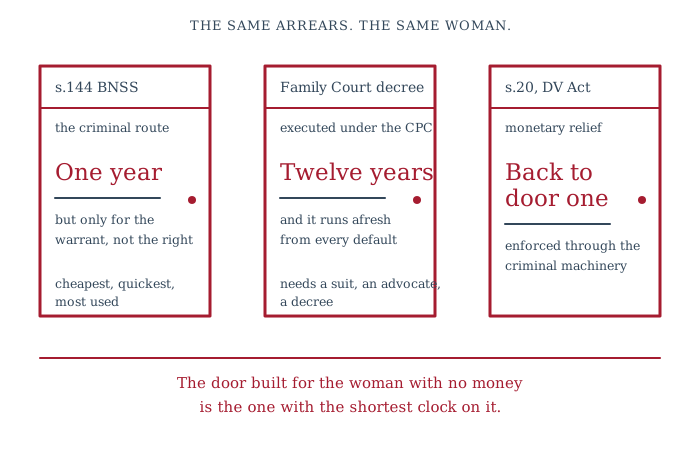
Now set the routes beside one another. The same woman, owed the same money by the same man, faces a one-year proviso if she took the criminal route and a twelve-year period if she holds a civil decree. Monetary relief under the Domestic Violence Act is enforced through the criminal machinery, and so returns her to the first door.8
Which door she walked through was rarely a considered choice. Section 125 exists precisely because it is quick, cheap and available without a suit. It was designed as a summary remedy for women who cannot fund litigation, and it is for that reason the most used. The result is that the route built for the woman with the least money carries the shortest clock on its face, and it is her arrears that are most often refused.
That the refusal is legally wrong is, in one sense, the smaller problem. The larger one is that the shortest clock was put on the poorest door to begin with.
Twenty-one years of saying the same thing
The Supreme Court has now addressed the recovery of maintenance three times over fifteen years, and each time it has moved in the same direction.
In Shantha alias Ushadevi v. B. G. Shivananjappa, 2005 INSC 266, it held that requiring a wife to file a fresh execution application for every unpaid instalment was unreasonable and contrary to the social purpose of the provision.9 In Poongodi it held that the proviso does not extinguish arrears. In Rajnesh v. Neha, 2020 INSC 631, it laid down comprehensive directions on maintenance, including the enforcement routes available: section 28A of the Hindu Marriage Act, section 20(6) of the Domestic Violence Act, section 128 of the criminal Code, and execution as a money decree under sections 51, 55, 58 and 60 and Order XXI of the Civil Procedure Code.10
Three interventions. One direction of travel. No ambiguity left to resolve.
In July 2026 the Allahabad High Court found it necessary to say it again. In Mala Kumari v. State of U.P. the Court held that a subsisting maintenance order creates a continuing obligation, that a wife cannot be made to file repeated execution applications as each month falls due, and that the one-year limitation restricts the issue of a warrant without eliminating the right to arrears or preventing enforcement.11
It then warned judicial officers that non-compliance with the directions of the Supreme Court may attract disciplinary and contempt proceedings.
Read that sequence slowly. Twenty-one years after Shantha, thirteen after Poongodi, six after Rajnesh, a High Court is threatening the courts below with contempt to secure compliance with propositions that were never seriously in doubt.
What that leaves
There is no doctrinal gap here. There is nothing for Parliament to fix and no question awaiting an authoritative answer. Every proposition a woman needs has been stated by the Supreme Court, more than once, in plain language.
What there is instead is a gap between the law as decided and the law as applied at the counter of a magistrate's court, and that gap is doing the work that a limitation period would do if one existed. A right that is refused for four years and then vindicated on appeal is not the same right as one that is honoured at the first asking. For a woman living on the arrears, the difference between them is the whole of the matter.
The narrower lesson is worth stating plainly, because it is the one that decides cases. The proviso bars a warrant. It does not bar the money. If a court says otherwise, the answer is Poongodi, and if that is not enough, the answer is that section 147 was never within the proviso's reach in the first place.
The wider lesson is harder to act on. When the same entitlement is given three limitation regimes according to which door the claimant entered by, and the shortest one is fixed to the door built for people without money, the inequality is not an accident of drafting that better judging can cure. It is in the architecture.
Filed under Women's Rights
- Proviso to s 125(3), Code of Criminal Procedure 1973; now the proviso to s 144(3), Bharatiya Nagarik Suraksha Sanhita 2023. The Sanhita came into force on 1 July 2024. ↩
- Poongodi v Thangavel, 2013 INSC 659, Supreme Court of India, judgment of 27 September 2013. ↩
- Kuldip Kaur v Surinder Singh, 1988 INSC 342 (1989), holding that imprisonment under s 125(3) is a mode of enforcement and not a mode of satisfaction of the liability. ↩
- s 128, Code of Criminal Procedure 1973; now s 147, Bharatiya Nagarik Suraksha Sanhita 2023. ↩
- Allahabad High Court, holding that the limitation in the proviso to s 125(3) does not extend to the enforcement power under s 128. ↩
- s 18, Family Courts Act 1984. Sub-section (1) covers decrees and orders other than orders under Chapter IX of the Code of Criminal Procedure; sub-section (2) covers orders made under that Chapter; sub-section (3) provides for execution by the Family Court which passed the decree or by a court to which it is sent. ↩
- Article 136, Limitation Act 1963, prescribing twelve years for the execution of any decree or order of a civil court, other than a decree granting a mandatory injunction. The third column provides that where the decree directs payment at recurring periods, time runs from the default in respect of which execution is sought. ↩
- s 20(6), Protection of Women from Domestic Violence Act 2005. The sub-section routes recovery of monetary relief through the machinery of the criminal Code. ↩
- Shantha alias Ushadevi v B. G. Shivananjappa, 2005 INSC 266, Supreme Court of India, 2005. ↩
- Rajnesh v Neha, 2020 INSC 631, Supreme Court of India, judgment of 4 November 2020 (Indu Malhotra and R. Subhash Reddy JJ). ↩
- Mala Kumari v State of U.P., Allahabad High Court, judgment of 26 July 2026 (Praveen Kumar Giri J). It is identified here by court, date and judge; the judgment is on the High Court’s own site. ↩