The Form Still Asks for the Father
A divorced woman raising a child alone in India will, sooner or later, meet the same question on four different pieces of paper. The school wants the father’s name, and his caste. The passport office wants his consent, or at least his name. If she wants to give the child her own surname, someone asks whether he has agreed. And if she wants to take back her own maiden name, the Government of India asks for her husband’s permission.
Most of these questions have already been answered, some of them more than once, by the Supreme Court, by High Courts and by the ministries that print the forms. The answer each time is that a mother’s name is enough. The forms have not caught up, and the gap between the rule and the counter is where single mothers spend their time and money.
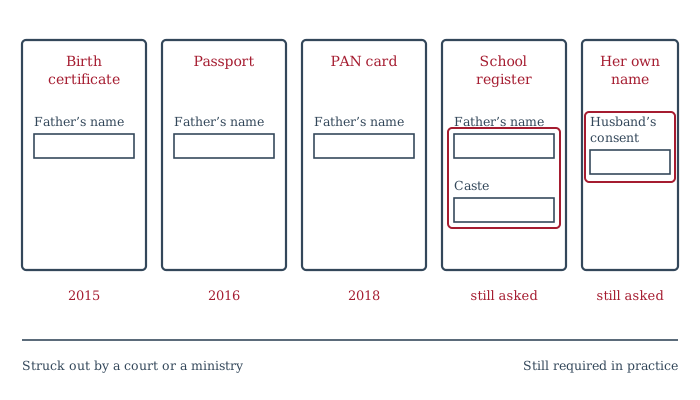
Her own name needs his consent
Start with the mother herself, because this is the one that surprises people.
A change of name in India is made effective by notification in the Gazette of India, which is run by the Department of Publication. Its guidelines say that a married woman who wants to return to her maiden surname must produce either a decree of divorce or a no-objection certificate from her husband.1 Asked about this in Parliament in July 2024, the Government explained that the requirement lets the husband raise any objection, or any legal consequence of a dispute or a court decree, before the change is published.2
Think about who this actually catches. A woman who is already divorced has the decree and can use it, though it means handing a court judgment about her marriage to a printing office in order to change her own name. The woman it really stops is the one who has separated and is waiting for a divorce, which in India can take years. She has no decree yet, and the only other way through is a letter from the man she is divorcing. He is the person least likely to sign it, and the rule hands him a veto over what she is called. I have found no equivalent requirement for a married man who wants to change his name.
The rule was challenged in the Delhi High Court in 2024 by Divya Modi Tongya, who was separated and wanted her maiden name back while her divorce was pending. The Court issued notice to the Union in February 2024.3 As far as I can find, the petition has not been decided, and the rule is still in force.
The passport: the rule changed in 2016, the counter did not
On paper, this one is solved. In December 2016 the Ministry of External Affairs changed the passport rules so that an applicant need give the name of only one parent, or a legal guardian. People who were separated or divorced no longer had to produce the divorce decree.4 The Passport Manual now says the online form permits the name of the father or the mother, “only one parent and not both”.
And yet mothers keep having to go to court for passports.
In September 2026 the Rajasthan High Court heard the case of a boy in his divorced mother’s exclusive custody. He had been issued a passport without his father’s name. When it came up for renewal, the passport office demanded an undertaking supplying the estranged father’s name, relying on a clarificatory notification of 2023. Justice Maneesh Sharma held that the authorities could not add at renewal a condition they had not imposed at issue, that the 2023 notification could not be applied mechanically, and that a single parent may apply for the child without the other parent’s name being endorsed.5 A month earlier, the same Court had ordered a passport for a 17-year-old whose father refused to sign the form for study abroad.6
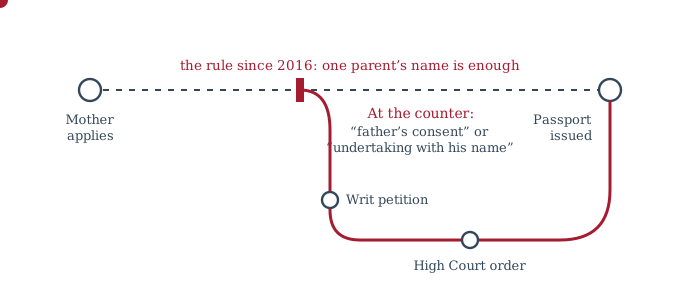
Both children got their passports. But both mothers needed a writ petition to get what the rules already gave them, and a mother who cannot afford a lawyer in the High Court does not get the benefit of either decision. A rule that works only after litigation does not work.
Why the father keeps coming back
The forms are not the root of this. The root is a statute.
Section 6(a) of the Hindu Minority and Guardianship Act 1956 says that the natural guardian of a Hindu minor is “the father, and after him, the mother”. In 1999 the Supreme Court in Githa Hariharan read “after” to mean “in the absence of”, so that a mother can act as guardian when the father is absent or uninterested.7 That rescued mothers in hard cases and left the statute untouched. The words are still in the Act, the father is still first, and every official who asks for his signature is reading the statute the way it is written. I have argued elsewhere that this hierarchy should go.8 Until it does, the burden stays on the mother to prove that he is absent enough.
The Supreme Court has chipped away at the edges. In 2015, in ABC, it held that an unwed mother can be appointed guardian without notice to the father, and directed that a single parent or unwed mother applying for a child’s birth certificate be asked only for an affidavit.9 In 2022, in Akella Lalitha, it held that a mother, as the child’s only natural guardian, can decide the child’s surname, including the surname of a new husband. It called a High Court direction to record the stepfather as “step-father” in documents “almost cruel and mindless of how it would impact the mental health and self-esteem of the child”, and said: “A name is important as a child derives his identity from it.”10
But look at the facts of Akella Lalitha. The father had died when the child was a few months old. The mother was the only natural guardian because there was no one else. A divorced mother is in a different position: the father is alive, often uninvolved, sometimes impossible to find, and still, on the face of section 6, ahead of her. So when she asks a school to change the child’s surname to hers, the school asks for his no-objection or a court order, and it is not wrong to be nervous.
The school register, and the caste that follows the father
School records are where all of this becomes permanent. The general register follows a child through every later certificate, and in many states it records not only the father’s name but also the child’s caste, which is presumed to be the father’s.
In February 2026 a Division Bench of the Bombay High Court at Aurangabad decided the case of a 12-year-old girl whose school records carried her biological father’s name and caste. He had been accused in a criminal case of a sexual offence against her mother, and a settlement had given the mother permanent custody and ended his role in the child’s life. The mother had changed the child’s name by gazette notification and asked the school to record the mother’s name and caste instead. The education authorities refused, citing the Secondary School Code.11
The Court quashed the refusal and ordered the school to replace the father’s name and caste with the mother’s. Three of its sentences apply far beyond the facts:
A school record is not a private note; it is a public document that follows a child across years.
Recognition of a single mother as a complete parent for purposes of a child’s civic identity is not an act of charity.
The State’s formats must not become moral judgments; they must become accurate instruments of welfare.
The caste point has a foundation in Supreme Court law. In Rameshbhai Naika in 2012, the Court held that the rule that the child of an inter-caste marriage takes the father’s caste is not inflexible: a child raised by the mother, in the mother’s community, can show that the mother’s caste is the one that describes the life the child has actually lived.12 That is a presumption the child can rebut. In practice it is applied by school clerks as a rule.
The Bombay judgment is right. But consider what it took: a gazette notification, an application, a refusal, a writ petition, and a Division Bench of a High Court, to change two entries in a school register. And the facts were about as strong as facts get. A mother whose ex-husband simply left, and committed no crime, has a harder case to make, and the same clerk to make it to.
What has been fixed, and how
It is worth noticing which problems have actually gone away, because they show what works.
Since December 2018, a person whose mother is a single parent need not give the father’s name to get a PAN card; the form simply offers the option to give only the mother’s.13 Since 2015, a single mother can get a birth certificate on her own affidavit. Since 2016, the passport form asks for one parent. In each case the fix was a change to the form, made once, applied to everyone, and requiring nothing from the mother but her own declaration.
The problems that remain are the ones where the form still leaves room for an official to ask for more: the passport counter that wants an undertaking anyway, the school that wants the father’s no-objection, the Gazette that wants the husband’s.
What would fix the rest
Three things, none of them complicated.
- Withdraw the husband’s no-objection requirement for a woman’s own name. Publication in the Gazette is itself notice to the world, including to a husband. If he has a legal objection, he can take it to court. He should not hold a veto in advance.
- One declaration, accepted everywhere. The PAN, passport and birth-certificate reforms all rest on the same idea: a single parent’s own declaration that she is the single parent. That declaration should be accepted by every school, board and government department, and should be printed on their forms, so that no clerk needs a court order to accept it.
- Amend section 6(a). As long as the statute says “the father, and after him, the mother”, every official has a textual reason to ask for him. Making both parents equal natural guardians would remove the reason, and with it most of the questions on these forms.
None of this asks the law to pretend the father does not exist. A father who is present, and who wants to be named, can still be named. It asks only that a mother who is raising a child alone not have to prove, again and again, to one office after another, something that the Supreme Court, the High Courts and the Government’s own forms already accept.
Filed under Women’s Rights
- The requirement is set out in the Department of Publication’s guidance on a change of maiden surname, and is the subject of the petition at n 3. For the reaction when it came to wider attention, see The Wire. ↩
- Rajya Sabha, Unstarred Question No. 698, answered on 29 July 2024. The reason given is paraphrased from the answer as reported. ↩
- Divya Modi Tongya v Union of India, W.P.(C) 3028 of 2024, High Court of Delhi, order of 29 February 2024 (Manmohan ACJ and Manmeet Pritam Singh Arora J) issuing notice. ↩
- See The News Minute on the December 2016 changes. The passage from the Passport Manual is quoted in the judgment at n 5. ↩
- Ekang Mishra v Union of India, High Court of Rajasthan at Jaipur, 2026:RJ-JP:37212 (Maneesh Sharma J), September 2026. The neutral citation identifies the judgment whichever database the reader uses. ↩
- Riddham Deora v Union of India, High Court of Rajasthan (Anoop Kumar Dhand J), August 2026. See ETV Bharat. ↩
- Githa Hariharan v Reserve Bank of India, 1999 INSC 66. ↩
- Why Mothers Are Still Not Equal Guardians Under Hindu Law. ↩
- ABC v State (NCT of Delhi), 2015 INSC 482, decided 6 July 2015. ↩
- Akella Lalitha v Konda Hanumantha Rao, 2022 INSC 759, decided 28 July 2022 (Dinesh Maheshwari and Krishna Murari JJ), para 11. ↩
- X.Y.Z. v State of Maharashtra, Writ Petition No. 15528 of 2025, High Court of Bombay, Aurangabad Bench, 2026:BHC-AUG:7179-DB (Vibha Kankanwadi and Hiten S. Venegavkar JJ). The passages quoted are from the judgment as reported by 24Law, 24 February 2026. ↩
- Rameshbhai Dabhai Naika v State of Gujarat, 2012 INSC 37, decided 18 January 2012. ↩
- Income-tax Rules 1962, r 114, as amended by notification of November 2018 with effect from 5 December 2018. See Business Today. ↩