Nirbhaya Changed the Law. It Did Not Change the Bus.
On 31 August the Delhi Police arrested the driver and the conductor of a sleeper coach. The offence they are accused of is said to have taken place nearly four weeks earlier, on the night of 4 August, on a bus that drove roughly forty-seven kilometres from Pari Chowk in Greater Noida to Kashmere Gate in Delhi, with a sixteen-year-old girl on board.1
She had got off at the wrong place in heavy rain and asked for a lift. The bus was not in service. It was empty, returning to a depot in north Delhi after repairs. She was told it was going where she needed to go. It was not.
Every account of this has reached for the same comparison, and the comparison is right. In December 2012 a young woman boarded a bus in Delhi that was not in service, and what happened on it changed Indian criminal law. The convictions and the death sentences were confirmed by the Supreme Court in Mukesh & Anr. v. State for NCT of Delhi & Ors., 2017 INSC 448, and the last challenges were rejected in Pawan Kumar Gupta v. State of NCT of Delhi, 2020 INSC 324, on the day the four men were hanged.7 What follows is about what that change did and did not reach.
Why this account is thinner than the ones you have read
I am not going to set out what is alleged to have been done to her, and I am not going to identify her.
Section 72 of the Bharatiya Nyaya Sanhita makes it an offence, punishable with up to two years and a fine, to print or publish the name of a person against whom an offence under sections 64 to 71 is alleged, or any matter which may make known her identity. Section 23 of the POCSO Act says the same where the victim is a child, and she is a child.2
The words that do the work are “any matter which may make known”. That is much wider than a name. It reaches the school, the class, the village, the district, the family circumstances and the particular route, and it reaches them cumulatively. No single detail identifies anyone. Four of them, in a small place, identify one girl.
This is not squeamishness on my part. It is a criminal provision, and in the first day of a case like this it is broken repeatedly and casually, by people who would describe themselves as being on her side.
What 2012 actually produced
The response to December 2012 was not nothing, and it is worth being accurate about it, because the accurate version is more damning than the cynical one.
A committee under Justice J.S. Verma reported in twenty-nine days. The Criminal Law (Amendment) Act 2013 followed, rewriting the sexual offences chapter, widening the definition of rape, creating new offences and raising sentences. A dedicated corpus, the Nirbhaya Fund, was set up to pay for women's safety.3
And then there was a fourth thing, which nobody remembers, because it is a rule about hardware rather than a sentence about punishment.
Rule 125H
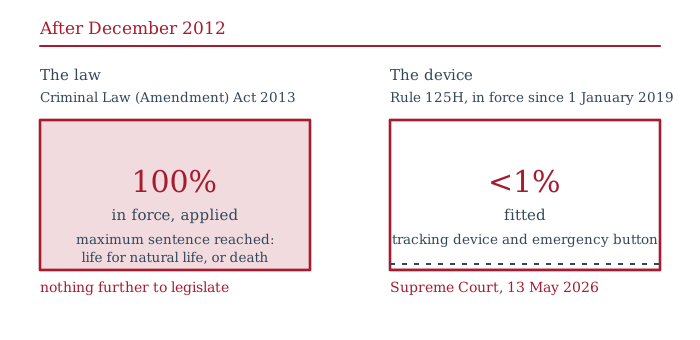
Rule 125H of the Central Motor Vehicles Rules 1989 requires every public service vehicle to be fitted with a vehicle location tracking device and one or more emergency buttons, built to the AIS-140 standard. It has applied since 1 January 2019. It does not apply to two-wheelers, three-wheelers or e-rickshaws.4
The emergency button is a physical, hard-wired thing. Pressing it sends an alert, with the vehicle's location, to a monitoring centre and on to the emergency response system.
Read that against the facts of this case. A girl is in a moving bus, at night, in the rain, with two men and no other passengers, on a route she cannot verify, in a vehicle nobody is expecting to be carrying anyone. The safeguard designed for precisely that situation is a button she can reach and a device that tells the state where the bus is.
Not a longer sentence afterwards. A button.
What the Supreme Court found in May
On 13 May 2026 the Supreme Court passed an order in S. Rajaseekaran v. Union of India, the road safety petition that has been running under Article 32 since 2012. It is the same petition I wrote about in the context of potholes. That order is interim and carries no neutral citation, so it is cited here by date; the most recent reported order in the petition is S. Rajaseekaran v. Union of India, 2025 INSC 1189, of 7 October 2025.
The Court recorded that fewer than one per cent of public service vehicles on Indian roads complied with Rule 125H.5
Fewer than one in a hundred, seven years after the rule took effect.
The Court directed that no public service vehicle be granted a fitness certificate under section 56 of the Motor Vehicles Act, or a permit under section 66, without verified installation of the tracking device and emergency button, reflected on the Vahan database. It ordered retrofitting of vehicles registered up to 31 December 2018, and integration with Vahan so that compliance could be monitored in real time.
That was in May. This was in August.
There is no stricter law left to pass
Within hours of a case like this the demand is for a stricter law. It is worth knowing where that demand runs out.
Section 70(2) of the Bharatiya Nyaya Sanhita deals with gang rape of a woman under eighteen. The punishment is imprisonment for life, which the section says means the remainder of that person's natural life, and a fine, or death. The fine is to be just and reasonable to meet the victim's medical expenses and rehabilitation, and is payable to her. Section 6 of the POCSO Act is to similar effect.6
The maximum is death. There is nothing above it. That lever was pulled in 2013, and pulled again in 2018 when death was extended to the rape of children, and it has no travel left.
So when the response to this case is a demand for stricter punishment, the honest answer is that the punishment is already the most severe the Constitution permits, and it did not prevent anything, because a sentence is not a preventive mechanism. It operates after a girl is already on the bus.
What has not been done is the ordinary, unglamorous, expensive work of getting a rule from 2019 onto ninety-nine per cent of a national fleet.
The four weeks
The offence is said to have occurred on 4 August. It became public on 31 August, when the arrests were made.
I do not know where that time went, and neither does anyone else writing about it today. It may be that she did not report it for weeks, which would be neither surprising nor blameworthy: a sixteen-year-old who had left home after an argument, who was assaulted by strangers and then put out on a road at night, has every reason in the world to say nothing to anybody. It may be that the delay lies somewhere in the machinery instead.
Those are very different failures and I am not going to guess which one this was. But the question is the right one to keep asking as the case proceeds, because it is the question that determines whether anything is fixed. If she could not bring herself to report it, that is a case for support services and for how children are spoken to about this. If the delay was institutional, that is a case about a police station.
What would have made a difference
Not a new offence. There was no gap in the offence.
A working button within reach of a passenger. A tracking device that made an empty bus off its route at night a thing the system could see. A fitness certificate that was refused until both were fitted, which is what the Supreme Court ordered in May and what the states have not delivered.
None of this is speculative technology. It is a rule that has been law since 2019, priced, specified and standardised, and ignored.
A closing thought
After 2012 India did two things. It wrote one of the most severe sexual offence codes in the world, and it wrote a rule about a button in a bus.
The first was done in months, because writing a sentence into a statute is something a legislature can do in a single session, and because severity is legible. Everybody can see that the state has acted.
The second is still not done, because it requires a state to do a dull thing continuously, in every district, on every vehicle, for years, while nobody is watching and no minister gets a photograph out of it.
A sixteen-year-old girl got into an empty bus in the rain because she was lost. Whatever else is true about that night, there was supposed to be a button.
- The account of the incident is taken from the reporting of 31 August 2026 and is as alleged. Nobody has been tried, and the accused are entitled to the presumption of innocence. See The Week and Onmanorama. I have deliberately omitted details carried in that reporting which, taken together, could identify the girl. ↩
- Bharatiya Nyaya Sanhita 2023, s. 72, which corresponds to s. 228A of the Indian Penal Code: printing or publishing the name or any matter which may make known the identity of a person against whom an offence under ss. 64 to 71 is alleged or found to have been committed is punishable with imprisonment up to two years and a fine, subject to narrow exceptions. Protection of Children from Sexual Offences Act 2012, s. 23, on the reporting of cases involving a child. ↩
- Report of the Committee on Amendments to Criminal Law (the Justice J.S. Verma Committee), January 2013; the Criminal Law (Amendment) Act 2013; and the Nirbhaya Fund, announced in the Union Budget of 2013. ↩
- Rule 125H, Central Motor Vehicles Rules 1989, requiring a vehicle location tracking device and one or more emergency buttons in public service vehicles, to the specification, testing and certification of AIS-140:2016 as amended, with effect from 1 January 2019. The rule does not apply to two-wheelers, three-wheelers or e-rickshaws. ↩
- Order dated 13 May 2026 in S. Rajaseekaran v. Union of India. Like the other interim orders in that petition, it does not carry a neutral citation, so it should be cited by case name and date. The most recent reported order in the same petition is S. Rajaseekaran v. Union of India, 2025 INSC 1189, of 7 October 2025, which is what the link above opens. The finding on compliance and the directions on fitness certificates under s. 56 and permits under s. 66 of the Motor Vehicles Act are reported by ThePrint and Deccan Herald. Confirm against the order before citing the percentage in a court filing. ↩
- Bharatiya Nyaya Sanhita 2023, s. 70(2); Protection of Children from Sexual Offences Act 2012, s. 6, as amended in 2019. ↩
- Mukesh & Anr. v. State for NCT of Delhi & Ors., 2017 INSC 448, decided 5 May 2017 (Dipak Misra, R. Banumathi and Ashok Bhushan JJ.). The later challenges were dismissed in Pawan Kumar Gupta v. State of NCT of Delhi, 2020 INSC 55, of 20 January 2020, and again in Pawan Kumar Gupta v. State of NCT of Delhi, 2020 INSC 324, of 20 March 2020, the day of the executions. Note the cause title: the appellant side is “& Anr.” and the respondent side “& Ors.” ↩
Filed under Women’s rights