The Right to Safe Roads, and What a Pothole Death Is Worth
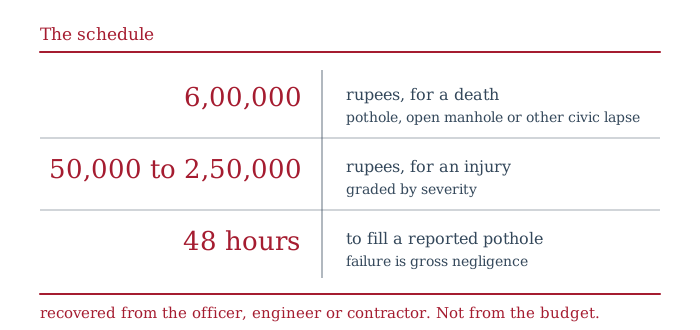
In October 2025 the Bombay High Court fixed a price. Six lakh rupees for a death caused by a pothole or an open manhole. Between fifty thousand and two and a half lakh for an injury, depending on how badly you were hurt. Any pothole reported to an authority to be filled within forty-eight hours, and a failure to do it treated as gross negligence.1
The reasoning behind the figure is the interesting part. The Court did not treat a pothole as a municipal housekeeping failure. It treated it as a breach of Article 21.
Which raises the question this essay is about. Is there a constitutional right to a road that does not kill you, and if there is, why has almost nobody ever been able to enforce it?
First, the numbers, and why you should not trust them
When the Supreme Court took up pothole deaths in July 2018, the figure placed before it was 14,926 deaths between 2013 and 2017. A Bench of Justices Madan B. Lokur and Deepak Gupta called it frightening, and observed that more people were dying in pothole accidents than in terrorist attacks.2
Note the two words that usually get dropped when that observation is quoted. The Court said the figure was frightening if true. It did not accept the number. It asked the Supreme Court Committee on Road Safety, headed by Justice K.S. Radhakrishnan, to look into it.
The Court was right to hesitate. Set the two series side by side:
- 2013 to 2017: 14,926 deaths, or roughly 2,985 a year.
- 2020 to 2024: 9,438 deaths, rising from 1,555 in 2020 to 2,385 in 2024.3
On their face, pothole deaths fell by a third between one five-year period and the next, while total road deaths in India rose to roughly 1.7 lakh a year. Nobody who has used an Indian road in the monsoon believes the roads got safer. What changed is more likely to be the recording.
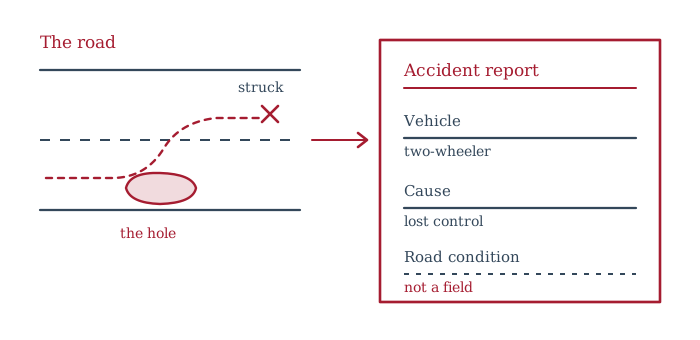
This matters legally, not just statistically. A pothole death is almost never recorded as a pothole death. It is recorded as a road accident, and the cause is entered against the vehicle or the rider: lost control, skidded, hit from behind. The hole that made the rider swerve is not a column in the form. It is also, very often, filled within days of the death, which means that by the time anyone asks a court to find a causal link, the evidence has been tarred over.
So the state is the only body counting, the count depends on officials recording their own department's failure, and the object of the complaint is routinely destroyed before the claim is made. Hold that thought, because it is the whole difficulty.
Where the right actually comes from
There is no Article of the Constitution about roads. The right is built, as most of Article 21 is, out of interpretation.
Article 21 has long been read as protecting not mere animal existence but life with dignity. Article 19(1)(d) guarantees the freedom to move freely throughout the territory of India, and a road is the physical infrastructure of that freedom. The Directive Principles add the state's duty to secure a social order for the welfare of the people and to raise the standard of living. None of that, on its own, gets you compensation for a broken collarbone.
The foundation is older and more specific. In Municipal Council, Ratlam v. Vardhichand, 1980 INSC 138, Justice Krishna Iyer held that a municipality's statutory obligations to the public are enforceable, and that a plea of no funds is not an answer to a statutory duty owed to residents.4 Ratlam was about open drains and public sanitation, but the principle transfers exactly. The obligation to maintain a road is not discretionary because the budget is short.
Every municipal statute in the country makes road maintenance an obligatory duty rather than a discretionary one. That is the statutory floor the constitutional argument is built on.
The problem: a statutory duty is not automatically a duty of care
Here is where a claim usually dies, and it is worth understanding properly, because it explains why the Bombay High Court had to go the route it did.
In Municipal Corporation of Delhi v. Subhagwanti, 1966 INSC 55, the Clock Tower in Chandni Chowk collapsed and killed a number of people. The Supreme Court held the Corporation liable. The structure was in its exclusive control, its condition was not something the victims could have known, and the duty to maintain it could not be delegated away.5 On that authority, a civic body is answerable for what its own infrastructure does to the public.
Then the current turned. In Rajkot Municipal Corporation v. Manjulben Jayantilal Nakum, 1997 INSC 34, a man walking along a footpath was killed by a falling roadside tree. The trial court and the High Court held the Corporation liable, reasoning that its statutory duty to maintain trees produced a tortious liability. The Supreme Court allowed the Corporation's appeal.6 A statutory power or duty does not by itself create a common law duty of care towards a particular individual. The claimant must still establish the duty, the breach, the foreseeability and the causation.
Rajkot is the reason a pothole suit in tort is uphill. You must prove that this authority owed you a duty, knew or should have known about this hole, had a reasonable opportunity to repair it, and that the hole caused the death. Against an opponent with unlimited time, and with the pothole itself long since filled.
Almost no family of a pothole victim in India has the money, the years or the evidence to run that case.
The route that works: public law compensation
Which is why the action has moved to writ jurisdiction, where a different doctrine applies.
Rudul Sah v. State of Bihar, 1983 INSC 85, established that a constitutional court may award monetary compensation in its writ jurisdiction for a violation of Article 21, without sending the victim off to file a civil suit.7 Nilabati Behera v. State of Orissa, 1993 INSC 113, put it on a firmer footing: the public law remedy is distinct from a private law claim in tort, it exists to vindicate the fundamental right itself, and sovereign immunity is no defence to it.8
That is the engine. It lets a High Court say that a pothole death violated Article 21 and order money paid, without any of the tort machinery that Rajkot put in the way.
What the Supreme Court has and has not done
The road safety litigation in the Supreme Court is S. Rajaseekaran v. Union of India, a petition under Article 32 filed in 2012 by an orthopaedic surgeon who was seeing the results of Indian roads arrive in his operating theatre. It has been running for more than a decade.
The July 2018 order is the one everyone quotes. It is worth being precise about what it was. It was an interim order in a pending petition. It recorded the Court's alarm, said families of those killed should be entitled to compensation as a tortious claim, and referred the question to a committee. It did not create an entitlement anyone could take to a counter and collect. Seven years passed.
The most recent substantial order, S. Rajaseekaran v. Union of India, 2025 INSC 1189, was passed on 7 October 2025 by Justices J.B. Pardiwala and K.V. Viswanathan.9 It is a serious piece of work, and it is worth saying plainly that it is not about potholes. It is about footpaths and pedestrian infrastructure: audits of existing footpaths by road-owning agencies and the NHAI, pedestrian crossings, and directions to every State and Union Territory to notify rules under sections 138(1A) and 210-D of the Motor Vehicles Act within six months, the second of these covering design, construction and maintenance standards for roads other than national highways.
That last direction is the one to watch. Enforceable maintenance standards, notified as rules, are what turn a pothole from bad luck into a measurable breach.
I flag the footpath point because a good deal of writing has merged this order with the pothole question and reported the Supreme Court as having declared a right to safe roads. It did not. The Court addressed pedestrian infrastructure. The pothole holding came from a High Court, a week later.
October 2025: the Bombay High Court supplies what was missing
In High Court on its own motion v. State of Maharashtra, neutral citation 2025:BHC-OS:18732-DB, a Division Bench of Justices Revati Mohite Dere and Sandesh Patil held that the right to have roads in reasonable condition is part of the fundamental right guaranteed by Article 21.1 Good and safe roads, the Court said, are an essential component of a meaningful life.
The proceedings began with a letter written in 2013 by Justice Gautam Patel about the state of Mumbai's roads, which the Court took up on its own motion. Twelve years of orders followed.
What the Court did in October 2025 was different in kind from what had come before, and the difference is procedural rather than rhetorical:
- A tariff. Six lakh rupees for a death. Fifty thousand to two and a half lakh for injuries, graded by severity.
- A deadline. Potholes to be attended to within forty-eight hours of being reported. Failure is gross negligence and attracts departmental action.
- A forum. Compensation committees at district level, with District Legal Services Authority involvement and a duty on the police to pass on intimation, so that a family does not have to find and fund an advocate to begin.
- A timeline for payment. Six to eight weeks, with interest running on delay.
- Personal liability. The money is recoverable from the officers, engineers and contractors responsible.
On the last point the Bench was blunt: unless those responsible are made personally accountable and compelled to bear the liability from their own pockets, they will not understand the gravity of the issue.
That sentence is the whole reform. A compensation order paid out of the municipal budget is paid by the public that was injured. It disciplines nobody. An order recovered from the engineer who signed off on the stretch changes the incentives of the person actually deciding whether to relay a road before the monsoon.
The people
I want to be honest about a limit here, because the request that prompted this essay was for all the cases in which people have died in potholes.
There is no such list. That is not an oversight in my research; it is the finding. India records thousands of pothole deaths a year in an aggregate statistic and identifies almost none of them. Only a handful ever reach a court, and those that do arrive as public interest litigation about roads in general rather than as a case in the name of the person who died. The 14,926 people behind the Supreme Court's 2018 figure have no names in any judgment.
The individual deaths that do surface, surface in journalism. In Bengaluru in October 2022, Umadevi, aged fifty, was riding pillion on a scooter driven by her daughter when the scooter swerved to avoid a pothole and was hit from behind by a bus. She died of her injuries. The Chief Minister ordered a preliminary police inquiry.10 Reporting in the same city found that pothole deaths were routinely under-recorded and that those responsible were almost never punished.
Look at how that case would be classified. A bus hit a scooter. The record will show a collision between two vehicles. The pothole, which is the reason the scooter moved into the bus's path, appears nowhere in the police file. Multiply that by a few thousand a year and you have the gap between what the roads do and what the statistics say they do.
This is why the Bombay High Court's direction that the police must pass on intimation to a compensation committee matters more than it looks. It is the first point in the chain where a pothole death is required to be identified as one.
Why the right will still be hard to enforce
Four obstacles survive October 2025.
The evidence disappears. The authority that is liable is also the authority that repairs the hole, and it has every reason to repair this one quickly. Photographs taken by the family in the first hours are often the only proof that will ever exist.
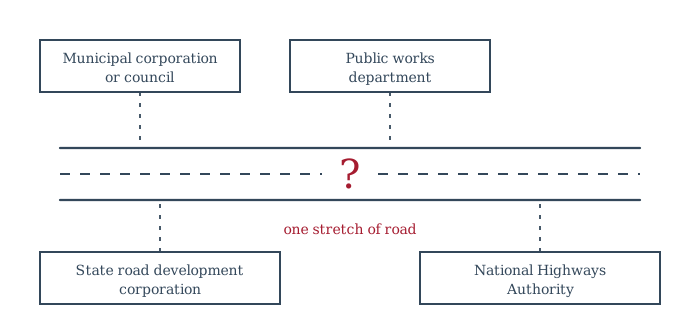
Nobody owns the road. A single stretch may belong to a municipal corporation, a public works department, a state road development corporation or the NHAI, and the first response to a claim is usually that the road belongs to somebody else. The Bombay order names the corporation, the council, the collector and the road authorities together, which helps, but the family still has to start somewhere.
The FIR points the wrong way. The criminal case, if there is one, is against the driver. Prosecuting a municipal engineer for a death caused by a road is close to unheard of.
It is one state. A High Court judgment binds within its jurisdiction. If you are injured on a road in Patna or Lucknow or Bengaluru, there is no tariff, no committee and no forty-eight hour rule. There is a right, and a writ petition you will have to bring yourself.
What would actually change it
Three things, none of them requiring a constitutional amendment.
Record the cause. A road condition field in the accident report, filled by the investigating officer, would produce the first honest count India has had, and would create the evidence a family needs.
Notify the standards. The Supreme Court has already directed rules under section 210-D of the Motor Vehicles Act for the maintenance of non-national-highway roads. Once a maintenance standard exists as a notified rule, a pothole stops being a misfortune and becomes a documented breach of a legal requirement.
Recover the money from the person, not the budget. The Bombay High Court has ordered it. Whether it actually happens is the test of whether any of this was real.
A closing thought
For decades the answer to a pothole was that the state should do better, which is a sentiment rather than a remedy. What changed in October 2025 was not the discovery of a new right. Article 21 has been capable of this reading for forty years, and Ratlam said in 1980 that a civic body cannot plead poverty against a duty it owes the public.
What changed is that one court attached a number, a deadline, a forum and a name to it. A right with a procedure is a right. A right without one is advice.
The rest of the country is still on advice.
- High Court on its own motion v. State of Maharashtra, Bombay High Court, neutral citation 2025:BHC-OS:18732-DB, Revati Mohite Dere and Sandesh D. Patil JJ. Confirm the date before citing: sources differ on whether the judgment is dated 13 or 14 October 2025, which is consistent with pronouncement on one day and signing or upload on the next, but I have not resolved it against the certified copy. The neutral citation is the locator to use; it identifies the judgment whichever database you read it in. For an account of the order see Moneylife. ↩
- Order dated 20 July 2018 in S. Rajaseekaran v. Union of India, W.P. (C) No. 295 of 2012, Madan B. Lokur and Deepak Gupta JJ. This was an interim order in a pending petition and does not carry a neutral citation. The figure of 14,926 deaths between 2013 and 2017 was the figure placed before the Court, which described it as frightening if true and referred the question to the Supreme Court Committee on Road Safety headed by Justice K.S. Radhakrishnan. See Business Standard. ↩
- Figures for 2020 to 2024 are drawn from reporting of the Ministry of Road Transport and Highways series Road Accidents in India: 1,555 pothole deaths in 2020 rising to 2,385 in 2024, and 9,438 across the five years. Total road accident deaths in 2023 were of the order of 1.7 lakh. I have taken these from secondary reporting of the MoRTH reports rather than from the reports themselves; if you are citing the numbers, take them from the relevant annual report. ↩
- Municipal Council, Ratlam v. Vardhichand, 1980 INSC 138, Krishna Iyer J. ↩
- Municipal Corporation of Delhi v. Subhagwanti, 1966 INSC 55. The collapse of the Clock Tower in Chandni Chowk; the Corporation held liable for a structure in its exclusive control. ↩
- Rajkot Municipal Corporation v. Manjulben Jayantilal Nakum, 1997 INSC 34, judgment of 17 January 1997. A pedestrian was killed by a falling roadside tree in 1975. The trial court and the High Court found the Corporation liable; the Supreme Court allowed its appeal, holding that a statutory duty does not by itself give rise to a common law duty of care towards an individual. ↩
- Rudul Sah v. State of Bihar, 1983 INSC 85. ↩
- Nilabati Behera v. State of Orissa, 1993 INSC 113, establishing that compensation in public law is a remedy distinct from a claim in tort and that sovereign immunity is not available against it. ↩
- S. Rajaseekaran v. Union of India, 2025 INSC 1189, order dated 7 October 2025, J.B. Pardiwala and K.V. Viswanathan JJ., in W.P. (C) No. 295 of 2012. The directions on rules under sections 138(1A) and 210-D of the Motor Vehicles Act are at paragraphs 35.16 and 35.17. The order is on the Court's own site: api.sci.gov.in. ↩
- Reported in the Deccan Herald, October 2022. The account of the incident and of the under-recording of pothole deaths in Bengaluru is journalism, not a judicial finding, and no court has tested it. ↩
Filed under Constitutional law