Rights a Child Cannot Claim
On paper, an Indian child is one of the most protected people in the world. The Constitution guarantees free and compulsory education. Statutes forbid child marriage, restrict child labour, punish sexual abuse with special courts and minimum sentences, and require a separate justice system for children in conflict with the law. India acceded to the UN Convention on the Rights of the Child in 1992.
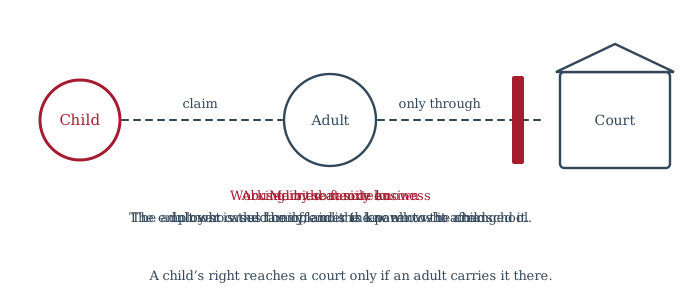
And yet anyone who has worked with children in India knows the feeling behind the question: in reality, children seem to have no rights at all. That is not quite right. Children have rights. What they lack is any way to claim those rights themselves, and that one gap explains most of the distance between the statute book and a child’s life.
What the law promises
The list is long. Article 21A makes free and compulsory education a fundamental right for every child aged six to fourteen. Article 24 forbids employing children under fourteen in factories, mines and other hazardous work. Article 39 directs the State to ensure that “the tender age of children” is not abused and that childhood is protected against exploitation.1 Under it sit the Right of Children to Free and Compulsory Education Act 2009, the Prohibition of Child Marriage Act 2006, the Child and Adolescent Labour (Prohibition and Regulation) Act 1986, the Protection of Children from Sexual Offences Act 2012, and the Juvenile Justice (Care and Protection of Children) Act 2015.
Few groups of adults have this much written law on their side. The question is why it reaches children so unevenly.
A right that only an adult can carry
An adult whose rights are breached can go to a police station, a lawyer or a court. A child cannot, in any practical sense, and in civil courts cannot in law either. A suit by a minor must be brought in the child’s name by an adult, called the “next friend”.2 Complaints, admissions, school fee disputes and police reports are all, in practice, made by parents or guardians. Children do not vote, so no politician needs their support. Every right a child has must be carried to the State by an adult.
Most of the time the adult is the parent, and most of the time that works. It fails in exactly the cases the laws were written for, because in those cases the adult who would have to complain is often the one breaching the right.
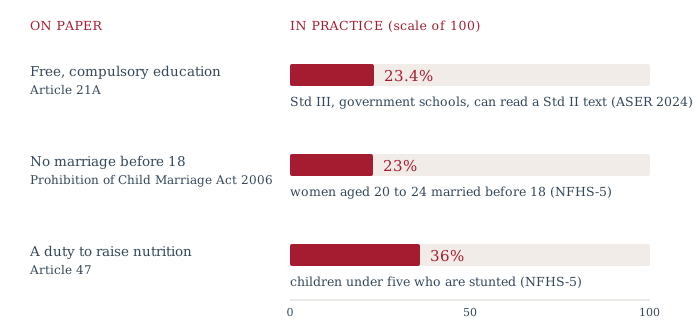
Child marriage. A child marriage is arranged by the family. The people expected to report it are the people who organised it. In the last national survey, taken some fifteen years after the 2006 Act, 23% of women aged 20 to 24 had been married before they turned eighteen.3 In 2024 the Supreme Court issued guidelines on enforcing the Act, including dedicated prohibition officers in every district, and held that child marriage takes away a child’s choice and autonomy, and damages the child’s health and education.4 The guidelines rely on officers and magistrates to act on their own information, because the family will not complain.
Child labour. The 2016 amendment to the child labour law banned the employment of children under fourteen in all occupations, and then made an exception: a child may help the family, or work in a family enterprise that is not hazardous, after school hours or during vacations.5 A large share of child labour in India takes place on family farms, in workshops and in home-based work. The exception places a large part of it outside the ban, and leaves the decision to the family that benefits from the work.
Sexual abuse. Sexual abuse of children is mostly committed by people the child knows, including relatives, neighbours and teachers. The National Crime Records Bureau recorded 67,694 cases under the POCSO Act in 2023, and found that most offenders were known to the child.6 When the abuser is in the family, or is someone the family depends on, reporting it can cost the family its standing or its income. The case may then be withdrawn, or the child may turn hostile at trial.
When a case does reach court
The POCSO Act requires its special courts to finish a trial, as far as possible, within a year of taking cognizance.7 As of January 2026 there were 398 exclusive POCSO courts in the country.8 Divided across the cases registered in 2023 alone, that is about 170 new cases for each court in a year, on top of the cases already waiting. Other special courts also try POCSO cases, so the arithmetic is rough, but the point holds: a child who reports abuse can wait years to give evidence, and in the meantime may live near the accused.
Even in proceedings that are about nothing but the child, the child is often not heard. Indian law sets no age at which a child’s views must be taken in a custody dispute, and where a judge does speak to the child, the conversation is often not recorded.9 The UN Convention says a child capable of forming views has the right to express them in all matters affecting the child.10 Indian courts decide custody on the child’s welfare, but they decide what welfare means largely by hearing the parents.
Rights measured in enrolment, not in learning
The right to education shows a different problem: a right defined by an input that can be met while the purpose of the right is missed. Article 21A has brought almost every child into a school building. What happens there is another matter. In 2024, only 23.4% of children in Standard III in government schools could read a Standard II text, and that figure was the highest the survey had ever recorded.11 The right is satisfied on the register. In the classroom, three out of four of those children cannot yet read a simple story.
The constitutional right also stops at fourteen. Children under six and adolescents between fourteen and eighteen have no fundamental right to education. Early childhood care is a Directive Principle, which no court can enforce.12 Nutrition is the same: Article 47 makes raising the level of nutrition a duty of the State, and about 36% of children under five are stunted.13
When the law treats children as adults
The law is not consistent about when a person stops being a child. Under the Juvenile Justice Act, a sixteen- or seventeen-year-old accused of a heinous offence can, after a preliminary assessment, be tried as an adult.14 Under the POCSO Act, the same sixteen-year-old cannot consent to any sexual activity, so a consensual relationship between two seventeen-year-olds is an offence. The Law Commission declined in 2023 to lower the age of consent, and suggested instead giving judges guided discretion in such cases.15 In both directions, the decision about when a child is old enough is made by adults, without asking the children it affects.
What would make the rights real
None of this needs a new list of rights. It needs a way for children to claim the rights they already have, without depending on an adult whose interests may conflict with theirs. Some of that is already in the statute book and simply unused. Child Welfare Committees, Child Marriage Prohibition Officers and the State Commissions for Protection of Child Rights exist in law. Many lack staff, budgets or the independence to act against a family or a government department.
Three changes would do more than any new statute. First, an independent lawyer for the child in custody disputes and in cases where the family is the accused, as the child’s own representative, not the parents’. Second, a duty on courts to hear and record the views of any child capable of forming them, in every proceeding about that child. Third, measuring rights by outcomes: not how many children are enrolled, but how many can read; not how many marriages were reported, but how many took place.
Children in India have rights. The problem is that the law gives them rights and then gives the power to claim those rights to adults. Until a child can be heard without an adult’s permission, many of those rights will stay on paper.
Filed under Child Rights
- Constitution of India, arts 21A, 24 and 39(e) and (f). Article 21A was inserted by the Constitution (Eighty-sixth Amendment) Act 2002. ↩
- Code of Civil Procedure 1908, Order XXXII, r 1. ↩
- National Family Health Survey-5 (2019 to 2021), as stated by the Government of India in “Bal Vivah Mukt Bharat: A Pledge Towards Child Marriage-Free India”, Press Information Bureau, 8 January 2026. ↩
- Society for Enlightenment and Voluntary Action v Union of India, 2024 INSC 790, decided 18 October 2024. ↩
- Child and Adolescent Labour (Prohibition and Regulation) Act 1986, s 3(2)(a), as substituted by the amending Act of 2016. ↩
- National Crime Records Bureau, Crime in India 2023, as reported in The News Minute. The Bureau recorded 1,77,335 crimes against children in all that year. ↩
- Protection of Children from Sexual Offences Act 2012, s 35(2). ↩
- Ministry of Law and Justice, Lok Sabha Unstarred Question No. 5579, answered 27 March 2026: 774 fast track special courts, including 398 exclusive POCSO courts, functional as of 31 January 2026. ↩
- See Indian Law Sets No Age for Hearing a Child in Custody Cases and Why a Child’s Custody Hearing Should Be on the Record. ↩
- UN Convention on the Rights of the Child 1989, art 12. India acceded to the Convention on 11 December 1992. ↩
- Pratham, Annual Status of Education Report 2024: National Findings. The figure was 20.9% in 2018 and 16.3% in 2022. ↩
- Constitution of India, arts 37 and 45. ↩
- Constitution of India, art 47; National Family Health Survey-5, as summarised in “NFHS-5: Uptick in Health Indicators across India”, Press Information Bureau, December 2021 (stunting down from 38% to 36%). ↩
- Juvenile Justice (Care and Protection of Children) Act 2015, ss 15 and 18(3). ↩
- Law Commission of India, Report No. 283, Age of Consent under the Protection of Children from Sexual Offences Act, 2012 (September 2023). ↩